

PM Surya Sarovar Yojana: India’s Floating Solar Leap
💡 PM Surya Sarovar Yojana: Key Findings
- ₹5,070 crore approved 31 July 2026 for 5,000 MW of floating solar with co-located battery storage.
- Storage is mandatory: a minimum 2-hour / 10,000 MWh system, built in to help states manage evening peak demand.
- Floating solar potential: 102.18 GWp — against only ~700 MW installed today.
- Expected impact: ~10 MT CO₂ avoided/year and 16,000–17,000 jobs.
- India’s solar capacity has grown fiftyfold in a decade — 3 GW (2014) to 162.15 GW (30 June 2026).
- India added 44.61 GW in FY2025–26 and 37 GW in CY2025, overtaking the US in annual additions.
India’s Union Cabinet has approved the Pradhan Mantri Surya Sarovar Yojana (PM-SSY), a ₹5,070 crore scheme to build 5,000 MW of floating solar with battery storage on the country’s reservoirs. The approval, cleared 31 July 2026, is the latest chapter in a decade that has taken India’s solar capacity from roughly 3 GW to more than 162 GW, per a PIB backgrounder published two days later. This piece covers what PM-SSY funds, the policy architecture behind that growth, and what floating solar adds to a grid already expanding faster than almost anywhere else.
What The PM Surya Sarovar Yojana Actually Funds
PM-SSY runs FY2026–27 to FY2030–31, with disbursement continuing through FY2032–33. Central Financial Assistance has two parts: up to ₹50 lakh per project for feasibility studies (bathymetry, hydrography, environmental assessments that floating installations need but land-based solar doesn’t), and ₹1 crore per MW after commissioning. All states and UTs are eligible. The scheme rests on a National Institute of Solar Energy (NISE) assessment estimating India’s floating solar potential at approximately 102.18 GWp — against only ~700 MW installed today, so the 5,000 MW target is a sevenfold expansion that still taps a small fraction of the resource.
Why Floating Solar Solves What Ground-Mounted Solar Can’t
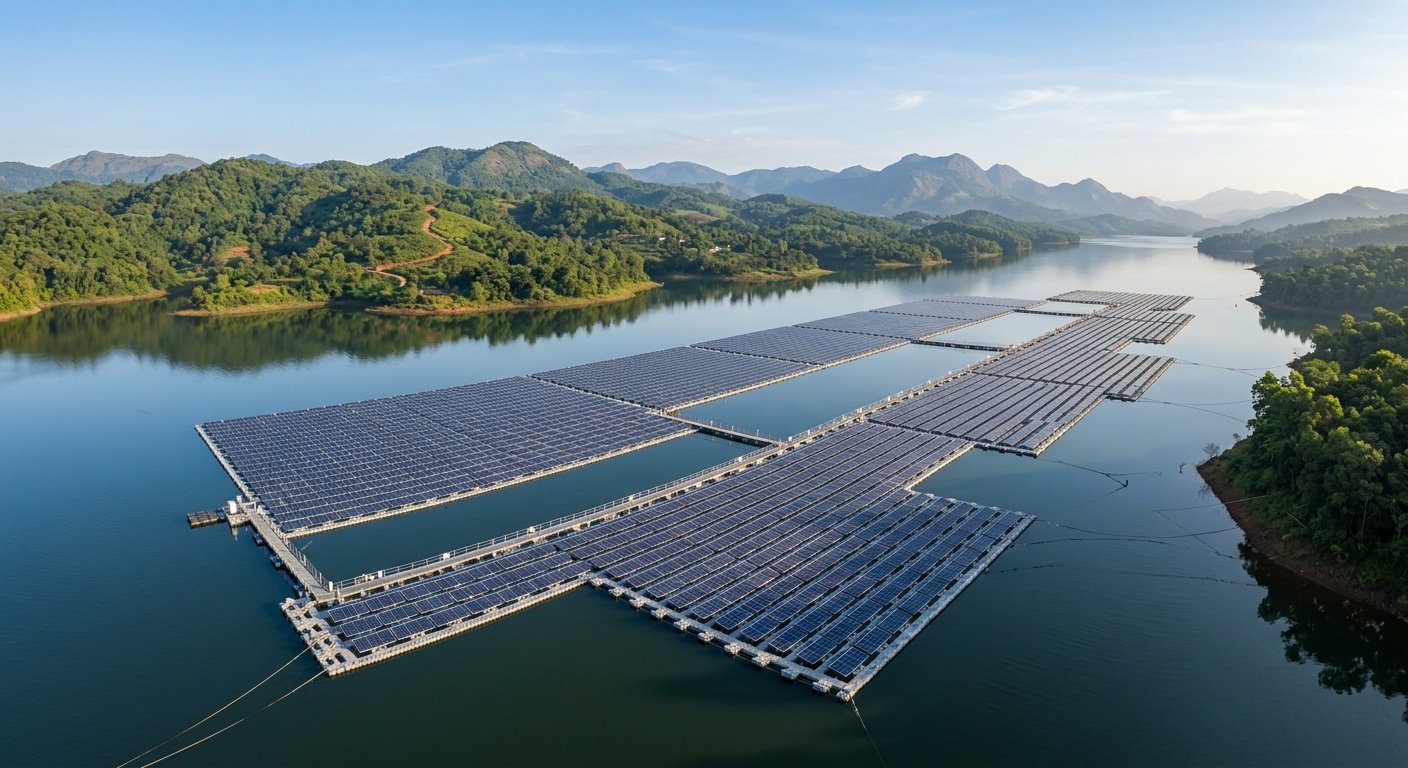
Ground-mounted solar parks need large, contiguous, cheap land — increasingly scarce near load centres. Floating solar sidesteps that by sitting on dams and industrial ponds India already owns, with three side benefits: it slows reservoir evaporation, the panels run cooler than on hot ground, and — since PM-SSY makes storage mandatory — every installation arrives dispatchable rather than purely weather-dependent. India already has a proof point: the 600 MW Omkareshwar Floating Solar Power Park on Madhya Pradesh’s Narmada river, though a 2024 storm damaged part of its anchoring — a reminder that reservoirs pose engineering demands land never does, which is why PM-SSY funds bathymetry studies upfront.
₹5,070 Cr
Total scheme outlay
5,000 MW
Floating solar target
10,000 MWh
Minimum co-located storage
102.18 GWp
NISE-estimated potential
16–17k
Expected jobs
A Decade That Took Solar From 3 GW To 162 GW
The PIB backgrounder that accompanied the approval frames PM-SSY as one milestone inside a bigger story: India’s solar capacity has expanded more than fiftyfold in a decade, from ~3 GW (2014) to 162.15 GW (30 June 2026). FY2025–26 was a record year alone — 44.61 GW added, nearly double FY2024–25’s 23.83 GW — and 37 GW across calendar 2025, surpassing the US in annual additions and making India the world’s second-largest solar growth market.
Large, utility-scale projects — Bhadla (Rajasthan), Pavagada (Karnataka), Rewa Ultra Mega (Madhya Pradesh) among them — account for 118.79 GW of that total; rooftop solar adds another 27.88 GW. Behind both sit 54 solar parks (39,188 MW sanctioned across 13 states, as of February 2026) and the Green Energy Corridor, which has evacuated 24,567.8 MW of renewable power through strengthened transmission, with roughly 44 GW more planned. We covered the fuller capacity and financing picture — including $45.72 billion in FDI since 2014 — in our earlier report on India’s renewable energy capacity crossing 288.58 GW.
The Five Pillars Behind India’s Solar Rise
PIB’s own backgrounder groups the policy work behind this growth into five reinforcing pillars — a useful map for understanding why PM-SSY looks the way it does.
1. Creating Vision: Climate Commitments
At COP26, India announced its Panchamrit goals — 500 GW of non-fossil capacity by 2030, net-zero by 2070 — later folded into its updated Nationally Determined Contributions under the Paris Agreement.
2. Creating Demand: RPOs, PM Surya Ghar And PM-KUSUM
Renewable Purchase Obligations require distribution companies to source a set share of power from renewables, at 35.95% for 2026–27. Below the utility level, PM Surya Ghar (43+ lakh households — see our full report) and PM-KUSUM (11.49 lakh off-grid pumps) pull demand into homes and farms, together contributing 16.3 GW — 36% — of FY2025–26’s solar additions; the same logic underwrites off-grid electrification for tribal households under PM-JANMAN.
3. Lowering Costs: Reverse Auctions And Tariff Discovery
Competitive e-Reverse Auctions, run largely through the Solar Energy Corporation of India, pushed tariffs from ~₹18/unit (2010) to a record ₹2.44/unit at the 2017 Bhadla auction — an 86% decline in seven years. That’s why India’s 2025 utility-scale solar LCOE was USD 35/MWh, against a global average of USD 44/MWh.
4. Enabling Infrastructure: Solar Parks And The Green Energy Corridor
The Solar Parks Scheme gives developers ready-built land, roads and grid connections instead of assembling each separately — the mechanism behind the 54 parks cited above. The Green Energy Corridor is the transmission-side complement; PM-SSY’s storage mandate plugs into the same logic, since dispatchable floating solar needs less new transmission just to smooth out solar’s midday peak.
5. Building Manufacturing: PLI And ALMM
The PLI Scheme for High-Efficiency Solar PV Modules (₹4,500 crore, expanded by ₹19,500 crore in 2022) attracted ~₹35,000 crore in investment and 10,000 jobs by October 2024; module manufacturing capacity grew from 2.3 GW (2014) to ~172 GW (March 2026), policed by ALMM since 2019. PM-SSY extends this logic to floatation systems and storage hardware — dovetailing with the manufacturing push in India’s grid-scale battery storage tender and the Rs 4.78 lakh crore grid storage plan.
India’s Global Solar Leadership
India’s solar push extends beyond its own grid. It co-founded the International Solar Alliance with France at COP21 (2015), now spanning the Maldives, Greece, Germany, Italy, Bhutan and others. In 2018, India proposed One Sun One World One Grid — now the Green Grids Initiative–OSOWOG with the UK (COP26, 2021), backed by Australia, France, the US and the ISA. During its G20 presidency, India helped build consensus on tripling global renewable capacity by 2030, a target PM-SSY’s reservoir-based capacity contributes toward.
What It Means
PM-SSY isn’t a new direction for Indian solar so much as a new surface for it — floating solar is what’s left once land near demand centres gets scarce and reservoirs start looking like the next available real estate. The more consequential design choice is the mandatory storage: new floating capacity arrives already able to shift power into the evening peak, instead of adding to the midday oversupply grid operators already manage. Co-locating batteries with generation at this scale is a small-scale preview of what a virtual power plant does across an entire grid — pooling distributed generation and storage so operators dispatch power when it’s needed, not just when the sun is shining. As India’s floating-solar base grows from 700 MW toward a 100+ GW potential, that dispatchability is likely to matter more than the raw megawatts.
📄 Download The Full PIB Backgrounder
“India’s Solar Growth Enters a New Era” — the full PIB backgrounder behind this report.
Download PDFFrequently Asked Questions
What is the PM Surya Sarovar Yojana?
A central scheme approved 31 July 2026 with a ₹5,070 crore outlay to build 5,000 MW of floating solar with co-located battery storage on India’s reservoirs, from FY2026–27 to FY2030–31.
How much floating solar potential does India have?
NISE estimates about 102.18 GWp across India’s reservoirs and inland water bodies — against roughly 700 MW installed today, so PM-SSY’s 5,000 MW target taps only a small share of it.
How is floating solar different from rooftop or ground-mounted solar?
It floats on reservoirs instead of sitting on land or rooftops — avoiding land competition, slowing evaporation, and running cooler in peak heat. PM-SSY projects also carry mandatory battery storage, unlike most rooftop or ground-mounted solar.
How much has India’s solar capacity grown since 2014?
From ~3 GW (2014) to 162.15 GW (30 June 2026) — more than fiftyfold, including a record 44.61 GW in FY2025–26 alone.
What is ALMM and why does it matter for solar manufacturing?
ALMM (since 2019) restricts government-backed solar projects to approved manufacturers. Paired with the PLI Scheme, it helped grow module manufacturing capacity from 2.3 GW (2014) to ~172 GW (March 2026).
When will PM Surya Sarovar Yojana projects be commissioned?
Sanctioned for FY2026–27 through FY2030–31, with disbursement continuing through FY2032–33, since Central Financial Assistance is released only after commissioning.
Source: PIB — Cabinet approval of PM Surya Sarovar Yojana | PIB — Cabinet press note | PIB Backgrounder — India’s Solar Growth Enters a New Era, Ministry of New and Renewable Energy, 31 Jul–2 Aug 2026 (PRID 2292465, 2292433, 2293256).