India Opens Global Tender for 10 GWh of Grid-Scale Battery Storage Manufacturing
India has launched a global tender for 10 GWh of grid-scale battery storage manufacturing under the PLI ACC Scheme. Here is what it means for India's 208 GWh storage gap.

The Ministry of Heavy Industries released a Request for Proposal on 15 July 2026, inviting global bids for the last 10 GWh of a 50 GWh giga-scale battery manufacturing programme — and for the first time, this slice isn’t earmarked for electric vehicles at all. It’s reserved specifically for Grid-Scale Stationary Storage: batteries built to sit inside a substation, not a car.
That distinction matters more than it sounds. India’s EV battery manufacturing push has dominated the storage conversation for years. This tender is a signal that the government now sees the grid itself — not just the vehicle fleet — as a battery market big enough to warrant its own dedicated manufacturing capacity.
What’s Actually Being Tendered
The Request for Proposal invites global bidders to compete for beneficiary status to build giga-scale Advanced Chemistry Cell (ACC) manufacturing facilities with a cumulative 10 GWh capacity, run through a two-stage Quality and Cost Based Selection (QCBS) process on the government’s Central Public Procurement (CPP) Portal. Tender documents went live on 15 July 2026, a pre-bid conference is scheduled for 29 July, bids close on 13 October, and technical bids will be opened the following day — a roughly three-month window for global cell manufacturers to put together proposals.
This is the remainder of a scheme that has already allocated most of its capacity. In May 2021, the Union Cabinet approved the National Programme on Advanced Chemistry Cell Battery Storage with a ₹18,100 crore outlay, targeting 50 GWh of domestic ACC manufacturing to cut India’s near-total dependence on imported battery cells. Of that target, 40 GWh has already been awarded to domestic manufacturers — largely for EV and consumer-electronics-grade cells. This final 10 GWh tranche is the first explicitly carved out for stationary grid storage rather than mobility.
Why Grid Batteries Are a Different Product, Not Just a Different Customer
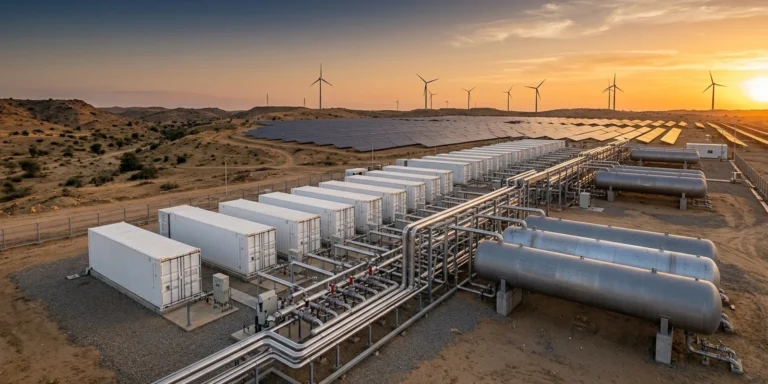
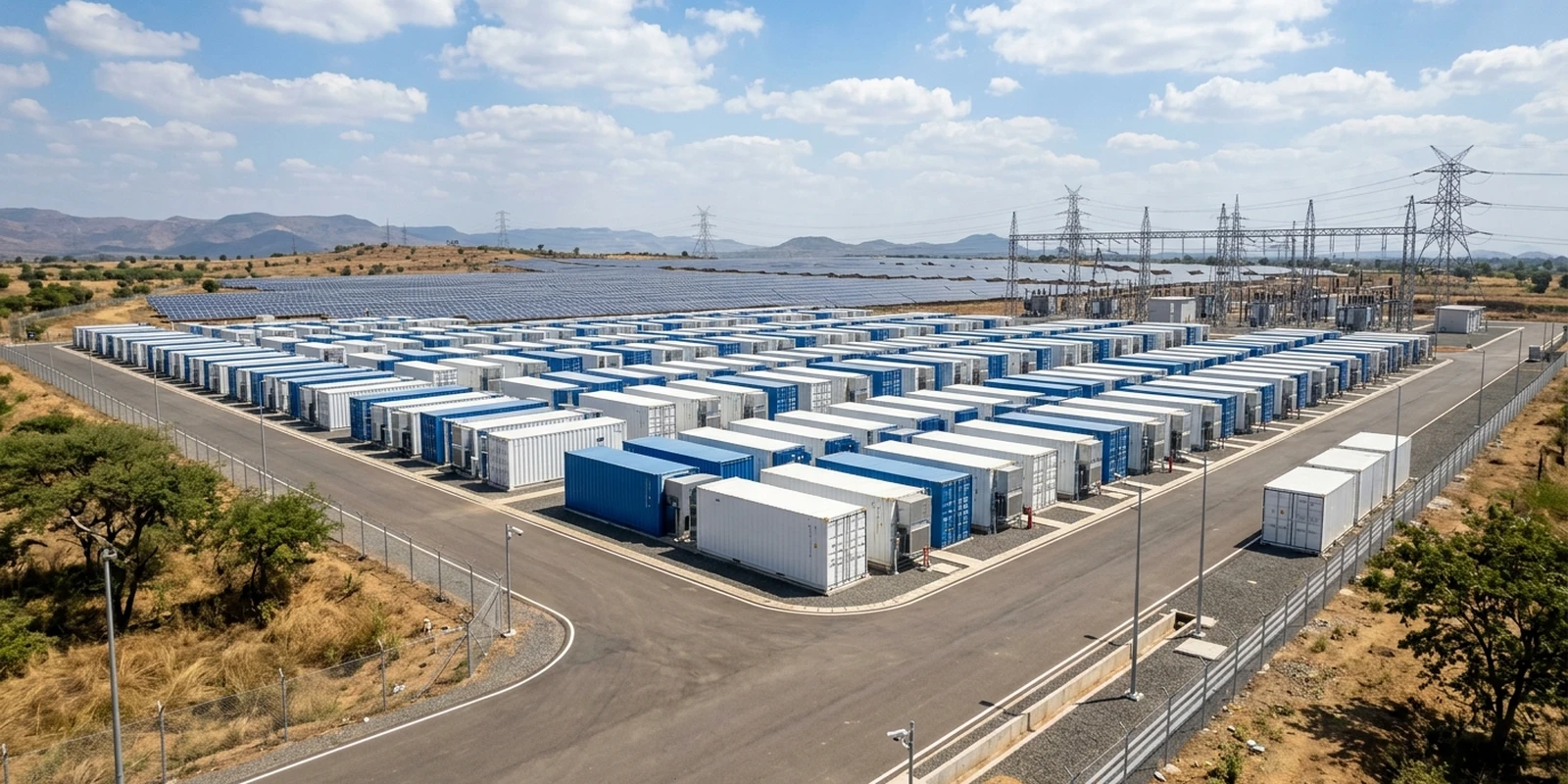
An EV battery is optimised for energy density and weight — it has to move down a highway. A Grid-Scale Stationary Storage (GSSS) battery sits still in a yard next to a solar park or substation, so density matters far less than cycle life, safety at scale, and cost per kWh over a 15-20 year operating life. Chemistries that are too heavy or too slow-charging for a vehicle — certain lithium iron phosphate (LFP) formulations, for instance — are often the preferred choice for stationary applications precisely because they trade energy density for durability and lower thermal risk when racked in large battery halls.
That’s an important nuance for reading this tender correctly: it isn’t simply “more EV battery factories.” It’s the government trying to seed a domestic supply chain for a category of battery that India barely manufactures today, even as demand for it is about to become very large.
The Bigger Number Behind This Tender
India’s renewable capacity is growing faster than its grid’s ability to absorb it smoothly. Solar and wind generation is inherently variable — it peaks at midday and drops to zero after dark — and without enough storage to bank the surplus, renewable-rich states are already seeing curtailment: solar and wind capacity that exists but isn’t dispatched because the grid can’t use the power when it’s generated.
The scale of the storage gap this is meant to close is large. The National Electricity Plan estimates India will need around 208 GWh of Battery Energy Storage System capacity by 2030 to support its 500 GW non-fossil generation target. The Central Electricity Authority’s longer-range estimate puts total storage needs at 411.4 GWh by 2031-32 (236.2 GWh from batteries, 175.2 GWh from pumped hydro), and one industry estimate projects requirements climbing to 888 GWh by 2035-36. Against numbers like that, even a fully built-out 10 GWh manufacturing line covers a small fraction of demand — which is exactly why this is being read as a first domestic-manufacturing step rather than a demand-side fix on its own.
Key Findings
- First GSSS-dedicated tranche: this is the first slice of the PLI ACC Scheme explicitly reserved for grid-scale stationary storage rather than EV or consumer battery cells.
- Scheme is nearly fully allocated: 40 of the 50 GWh target capacity has already gone to domestic manufacturers; this 10 GWh RFP closes out the programme.
- Transparent, competitive process: two-stage QCBS bidding conducted online via the CPP Portal, with technical bids opened 14 October 2026.
- Import substitution is the explicit goal: the scheme aims to reduce dependence on imported ACCs and build a “globally competitive” domestic battery ecosystem.
- The demand side dwarfs the supply being built: India’s own planning estimates put 2030 storage needs at roughly 20x this single tender’s capacity.
- Complementary to VGF schemes: this manufacturing-side tender runs alongside separate Viability Gap Funding schemes (2024 and 2025) supporting roughly 43 GWh of BESS project deployment — one funds factories, the other funds installed projects.
What It Means for India’s Energy Storage Sector
For renewable energy developers, more domestic grid-battery manufacturing capacity should eventually mean shorter lead times and less currency risk than importing cells, though the first plants from this tender won’t be running for a few years yet. For DISCOMs and grid planners, it’s one input toward closing a storage gap that, if left unaddressed, translates directly into curtailed renewable generation and higher balancing costs passed through to consumers. For battery manufacturers globally, it’s a signal that India’s ACC PLI programme — long associated almost entirely with EV batteries — is broadening into a second, potentially larger addressable market in grid storage.
The real test will be delivery: whether the successful bidders can bring 10 GWh of stationary-storage-grade cell manufacturing online fast enough to matter against a demand curve that industry estimates already put in the hundreds of gigawatt-hours by the early 2030s.
Source: Press Information Bureau, Government of India — Ministry of Heavy Industries, 15 July 2026 (Release ID 2284916).