India’s First Hydrogen Fuel-Cell Train Explained: Inside the Jind-Sonipat Project
India's first hydrogen fuel-cell train began service on the Jind-Sonipat line on 17 July 2026. How the 2,600-passenger, 10-car train works, its safety systems, and how it compares to hydrogen rail in Germany, Japan and China.

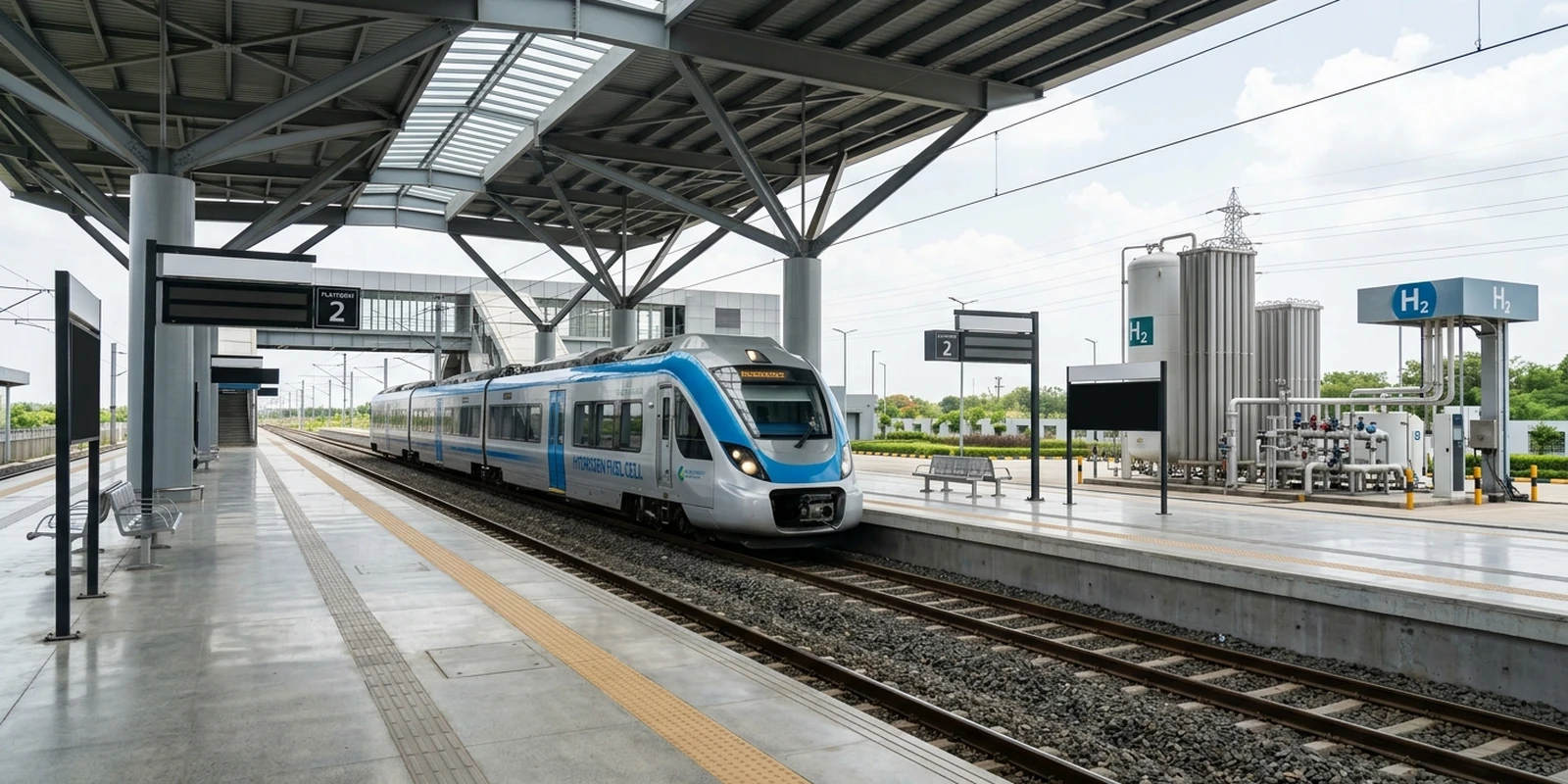
On 17 July 2026, Prime Minister Narendra Modi flagged off India’s first hydrogen fuel-cell train at Jind, Haryana — and with it, Indian Railways joined a very short list of countries running hydrogen-powered passenger trains outside a pilot lab. The 10-coach train now operates on the 89-km Jind–Sonipat section of Northern Railway, carrying up to 2,600 passengers on a fuel that produces nothing but water vapour as exhaust.
It’s easy to read that as a one-line curiosity. It’s actually a bigger deal than it sounds, for a reason most coverage skipped: two of the countries that got here first — Germany and Japan — have either scaled back or never scaled up their hydrogen trains. India built a 10-car configuration, reportedly the longest hydrogen passenger trainset attempted anywhere, and paired it with dedicated refuelling infrastructure designed to third-party safety standards. Here’s what’s actually running, how it works, and why the infrastructure choices matter more than the ribbon-cutting.
How a Hydrogen Train Actually Generates Its Own Power
A hydrogen train doesn’t burn anything. Each of the train’s two Hydrogen Driving Power Cars (DPCs) houses a Proton Exchange Membrane Fuel Cell (PEMFC), a bank of lithium iron phosphate (LFP) batteries, and hydrogen storage cylinders. Inside the fuel cell, hydrogen reacts electrochemically with oxygen drawn from the surrounding air. The reaction produces electricity that drives the traction motors — and water vapour, and nothing else. There’s no combustion, no exhaust stack, no diesel genset idling at the platform.
The appeal for Indian Railways is specific: hydrogen carries roughly 120 MJ/kg of energy versus diesel’s 43 MJ/kg, and unlike a battery-electric train, refuelling takes minutes rather than hours. That makes it a candidate for routes that are too long for battery trains but not yet profitable to electrify with overhead wires — a real gap, even in a network where over 99% of Broad Gauge route-km are now electrified.
Why Jind: the Refuelling Infrastructure Is the Actual Investment
The train itself is the visible part. The harder engineering problem — and the part that determines whether this scales beyond one demonstration corridor — is the hydrogen production, compression, storage and dispensing facility built alongside it at Jind. It is described as the country’s largest railway hydrogen storage and refuelling facility, holding close to 3,000 kg of compressed hydrogen at a time, with a standby compressor to keep refuelling uninterrupted.
That facility needed regulatory sign-off most transport stories never have to mention: the Petroleum and Explosives Safety Organisation (PESO) issued the licence covering storage and dispensing of compressed hydrogen gas at the site, with the system designed to NFPA-2 (fire protection) and ISO 19880-series (hydrogen fuelling) standards. An independent third-party safety assessment was carried out by TÜV SÜD, Germany — the same class of certification body used for hydrogen refuelling stations in Europe.
Built-in Safety Systems
- Hydrogen leak, flame and heat detectors at production, storage and dispensing points, feeding continuous monitoring
- Automatic hydrogen supply cut-off if heat, flame or smoke is detected anywhere in the system
- Non-stop ventilation running through the train at all times
- A dedicated emergency mode in the loco pilot’s cabin to move the train to safety if needed
- Real-time system health readout for the loco pilot, plus trained/certified crews and technical staff riding the initial services
- Maintenance depot at Shakurbasti, Delhi, prepared and equipped specifically for hydrogen train servicing
Key Findings
- First of its kind in India: designed, developed and manufactured indigenously from concept through prototype, under RDSO’s technical specifications — not an imported trainset.
- Among the longest hydrogen passenger trains globally: most operating hydrogen trains worldwide run 2–3 coaches on short regional routes; India’s is a 10-coach, 2,600-passenger configuration.
- Dual power source per car: each DPC pairs a 1,200 kW fuel cell with LFP batteries, giving the train buffered power delivery rather than relying on the fuel cell alone.
- Speed profile: approved for 75 km/h commercial operation with a 110 km/h design speed; test runs reportedly touched 120 km/h.
- Independent certification: full system safety assessment by TÜV SÜD, Germany, against NFPA-2 and ISO 19880 hydrogen-handling standards.
- Dedicated hydrogen ecosystem: a purpose-built ~3,000 kg storage and refuelling facility at Jind, separate from the train procurement itself.
- India joins a select group: Germany, Japan, China, France and the US have each tested or run hydrogen trains; Germany’s Lower Saxony fleet of 14 Coradia iLint units was largely pulled from service in late 2024, and Japan’s Hybari (Toyota fuel cells, Hitachi batteries) remains in testing on Tokyo-area lines rather than commercial service.
How India’s Approach Compares Globally
Germany was first to commercialise hydrogen passenger rail, running Alstom’s Coradia iLint on non-electrified regional lines in Lower Saxony from 2018. But by late 2024, operators had withdrawn most of that 14-unit fleet from service — a reminder that early-mover status doesn’t guarantee durability, and that refuelling economics and maintenance costs matter as much as the propulsion technology itself. Japan’s JR East has been testing its Hybari hydrogen hybrid train, built with Toyota fuel cells and Hitachi battery systems, on the Tsurumi and Nanbu lines near Tokyo since 2022 — still a trial programme, not a scheduled service. China has taken a different route, deploying hydrogen trams and urban trains concentrated around Chengdu rather than long-distance passenger rail.
Seen against that backdrop, the Jind–Sonipat project is a genuine bet rather than a copy of an existing template: a longer trainset, higher passenger capacity, and infrastructure sized for daily commercial operation from day one rather than a multi-year trial. Whether that bet pays off will depend on refuelling costs and hydrogen supply economics over the next few years of operation — the same variables that tripped up Germany’s programme.
What It Means for India’s Energy Transition
Indian Railways has spent the past decade electrifying its network, and that strategy has worked: more than 99% of Broad Gauge route-km now run on overhead wires, cutting diesel dependence sharply. Hydrogen fuel cells target the residual gap — branch lines, hilly terrain, or corridors where overhead electrification isn’t yet economical — without falling back on diesel. It also builds a domestic hydrogen-handling capability (compression, storage, dispensing, safety certification) that has applications well beyond railways, from heavy trucking to industrial process heat, at a time when India’s National Green Hydrogen Mission is trying to build exactly that kind of ecosystem.
For now it’s one 89-km corridor. The infrastructure choices — PESO licensing, international-standard safety certification, indigenous design under RDSO — are what determine whether this becomes a template Indian Railways repeats on other non-electrified stretches, or a well-engineered one-off. That answer plays out over the next few years of daily operating data, not the inauguration.
Source: Press Information Bureau, Government of India — Ministry of Railways, 16 July 2026 (Release ID 2285240) | PIB Backgrounder: India’s First Hydrogen-Powered Train, 16 July 2026 (Release ID 2285268).