

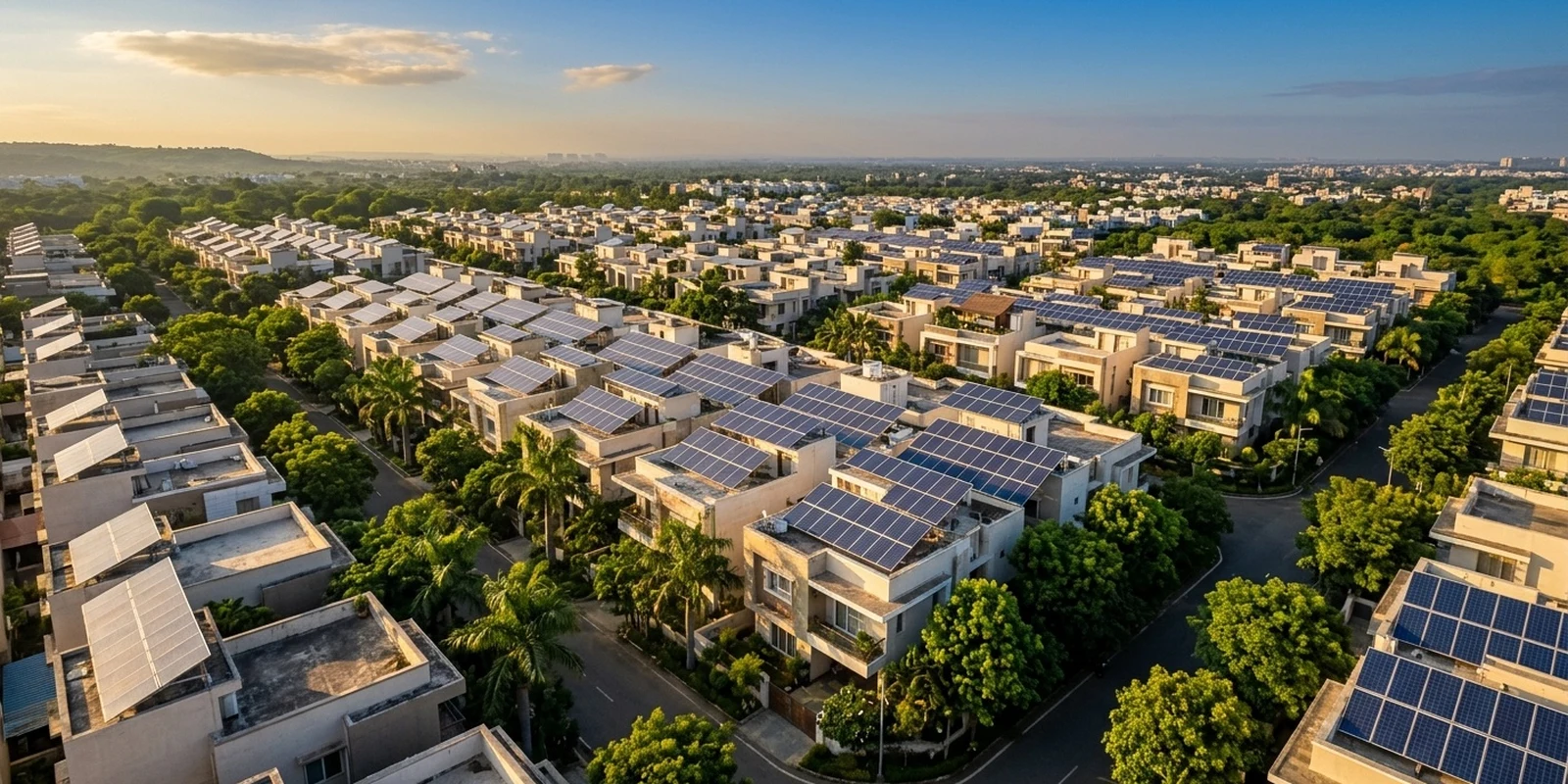
PM Surya Ghar Rooftop Solar Households Cross 48 Lakh In 2026
☀️ PM Surya Ghar Rooftop Solar Households: Key Highlights
- 48,02,717 households have benefited under PM Surya Ghar: Muft Bijli Yojana via 39,72,447 installed rooftop solar systems, since its February 2024 launch, as on 22 July 2026.
- FY2025-26 alone added 22.71 lakh households and 6.7 GW of capacity from 18.71 lakh systems — very nearly half of the scheme’s entire household count in a single year.
- Collateral-free bank loans are now available at 5.75% p.a. (repo rate + 50 bps) over a 10-year tenure, alongside higher subsidy support for the first 2 kWp of capacity.
- RESCO/Utility-Led Aggregation models let a third party own and maintain the rooftop system, so households can go solar with no upfront cost.
- Over 18.93 lakh beneficiaries have reported zero electricity bills for at least one billing month after installing rooftop solar.
- The government is converging the scheme with PM-KUSUM and the Solar Didi Programme to widen adoption among farmers and rural women.
India’s push to put solar panels on its rooftops has crossed a real milestone. As of 22 July 2026, PM Surya Ghar rooftop solar households have reached 48,02,717 — nearly 48 lakh homes now generating their own electricity — built on 39,72,447 installed systems since the scheme launched in February 2024. That’s a striking number for a subsidy programme barely two-and-a-half years old, detailed alongside its subsidy structure, financing window, and a coordinated push to reach households it hasn’t touched yet, in three written replies the government gave the Rajya Sabha on 28 July 2026.
What Is PM Surya Ghar: Muft Bijli Yojana?
PM Surya Ghar: Muft Bijli Yojana (PMSG: MBY) is India’s national rooftop-solar subsidy scheme for homes. The Prime Minister launched it on 13 February 2024; the Union Cabinet formally approved it two weeks later with a total outlay of ₹75,021 crore, targeting rooftop solar for one crore (10 million) households. The idea: subsidise a rooftop system enough that a household’s own generation covers most of its power needs — up to 300 free units a month for a typical installation — while surplus is exported back to the grid under net metering. Run by the Ministry of New and Renewable Energy (MNRE), it’s entirely demand-driven: any residential consumer with a grid-connected electricity connection, urban or rural, can apply directly on the national portal, pmsuryaghar.gov.in.
PM Surya Ghar Rooftop Solar Households: 48 Lakh And Counting
Since launch, PMSG: MBY has enabled installation of 39,72,447 rooftop solar (RTS) systems, benefiting 48,02,717 households as on 22 July 2026 — households outnumber systems because some installations (housing societies, multi-family buildings) serve more than one household off a single rooftop system.
The growth-rate context is the real story here. In FY2025-26 alone, 18.71 lakh RTS systems were installed, adding 6.7 GW of cumulative solar capacity and benefiting 22.71 lakh households — very nearly half of the scheme’s entire household count added in just one of its two-and-a-half years. A subsidy programme that started slowly in its first year is now running at a genuinely industrial pace.
Where The Money Is Going: Budget vs Actual Spending
The government also disclosed year-wise budget estimates against actual expenditure under the scheme:
| Financial Year | Budget Estimate (₹ Cr) | Expenditure Incurred (₹ Cr) |
|---|---|---|
| 2024-25 | 6,250 | 7,822.92 |
| 2025-26 | 20,000 | 16,166.23 |
| 2026-27 (as on 22.07.2026) | 22,000 | 10,392.48 |
FY2024-25 actually overshot its own budget by nearly 25% — a sign that early household demand outran planning estimates. FY2025-26, the scheme’s biggest household-addition year, came in under its higher ₹20,000 crore allocation, most likely reflecting the normal lag between a system being commissioned and its subsidy claim being paid out, rather than any slowdown on the ground. FY2026-27’s figure is only a part-year number, four months in as of the reply date.
Making Rooftop Solar Affordable: Subsidy, Loans, And Zero-Upfront Models
For an average household, the two questions that matter most are “what does it cost me” and “how do I pay for it.” Under the scheme’s subsidy structure, central financial assistance (CFA) covers a larger share of the first 2 kWp of capacity — roughly ₹30,000 per kW for the first 2 kW (around ₹60,000 for a typical 2 kW system), with a smaller top-up for a third kW. The government has now made that first-2-kWp support even stronger, specifically to help middle-income and economically weaker households clear the affordability bar.
For whatever the subsidy doesn’t cover, nationalised banks now offer collateral-free loans at a concessional rate of repo rate plus 50 basis points — currently 5.75% per annum — over a 10-year tenure. That’s a materially cheaper, longer-tenure loan than most households could get for a comparable home-improvement expense, and no collateral means no property risk to access it.
Zero Upfront Cost: The RESCO/ULA Route
The scheme has also folded in RESCO (Renewable Energy Service Company) and Utility-Led Aggregation (ULA) models for households that can’t self-finance even the subsidised balance. Under these, a third party — a solar company or the local utility — installs, owns and maintains the rooftop system at no upfront cost; the household simply pays for the electricity it consumes, typically below the grid tariff. That removes the single biggest real-world barrier to adoption: finding ₹1-3 lakh upfront, even after a subsidy.
The Households With Zero Electricity Bills
The most relatable proof point in the government’s disclosure: over 18.93 lakh beneficiaries — reported by DISCOMs across the country, including rural households — have received a zero electricity bill for at least one billing month, depending on how much of their own generation they consume directly. That’s not a theoretical benefit; it’s a line item that has genuinely disappeared from nearly two million households’ monthly budgets.
Who Can Apply — And Who Doesn’t Get The Subsidy
PMSG: MBY is open to any residential consumer with a grid-connected DISCOM connection, including rural households, via the national portal. Government, commercial and institutional buildings (schools, hospitals, offices) can also install rooftop solar under the scheme’s broader ambit, but don’t receive central financial assistance — the government’s reasoning is that it’s already financially viable for these categories without a subsidy. The subsidy rupees are deliberately targeted at the residential segment that actually needs the push.
Joining The Dots: PM-KUSUM And The Solar Didi Programme
The government used the same Rajya Sabha sitting to detail how PM Surya Ghar is being deliberately converged with other schemes rather than run as a standalone programme. On the agriculture side, PM-KUSUM now converges with the Agriculture Infrastructure Fund for easier financing, the Revamped Distribution Sector Scheme (RDSS) for solarising segregated agriculture feeders, the Per Drop More Crop micro-irrigation push, replacement of old pumps with energy-efficient ones, and the Gram Urja Swaraj Campaign for village-level self-sufficiency.
On the residential side, PM Surya Ghar converges with the Ministry of Housing and Urban Affairs’ Solar Didi Programme, which trains women Self-Help Group members under DAY-NULM to install and service rooftop systems — a local, women-led solar workforce alongside the subsidy. District Mineral Foundation (DMF) funds are also being channelled toward PM Surya Ghar for BPL households, PMAY beneficiaries and other vulnerable groups — stitching the scheme into India’s broader rural livelihoods and welfare financing architecture, not just its climate goals.
What It Means
At nearly 40 lakh installations and 48 lakh households, rooftop solar has stopped being a pilot and become a measurable share of how India generates power — one rooftop at a time, rather than one utility-scale plant at a time. It’s a different growth path from the grid-scale renewable story this site has tracked separately (India’s installed base crossing 288.58 GW, backed by a rapidly expanding battery and pumped-storage buildout) — but arguably the more consequential one for an average household’s monthly budget. Multiply nearly 40 lakh individual rooftop systems together and you get exactly the kind of distributed, small-scale generation base that a virtual power plant is built on — millions of tiny power plants that can, in principle, be aggregated and coordinated as one.
As more of these households produce more solar at midday than they consume, the question shifts from “how do I get subsidised solar” to “what do I do with the extra units.” Net metering credits that surplus back to the grid today; elsewhere in the ecosystem, models that let a household trade its extra solar directly with a neighbour — peer-to-peer energy trading — are already being explored as the next step once net metering hits its natural ceiling. And the convergence with PM-KUSUM and the Solar Didi Programme is a signal in itself: the government is treating rooftop solar as much an equity and livelihoods tool as a climate one, routing financing and training toward farmers, rural women and low-income households rather than leaving adoption to whoever can afford to move first.
Frequently Asked Questions
What is PM Surya Ghar: Muft Bijli Yojana?
India’s national rooftop-solar subsidy scheme for households, launched 13 February 2024 with a ₹75,021 crore outlay, aimed at covering up to 300 free units of electricity a month via a subsidised rooftop system.
How many households have benefited from PM Surya Ghar so far?
As of 22 July 2026, 48,02,717 households have benefited via 39,72,447 installed rooftop solar systems since the scheme’s February 2024 launch — including 22.71 lakh households added in FY2025-26 alone.
What subsidy does PM Surya Ghar offer for rooftop solar?
Central financial assistance covers a larger share of the first 2 kWp — roughly ₹30,000 per kW — with a smaller top-up for a third kW; the government recently strengthened this first-2-kWp slab specifically for middle-income and economically weaker households.
Can I get a loan for rooftop solar under PM Surya Ghar?
Yes. Nationalised banks offer collateral-free loans at a concessional rate of repo rate plus 50 basis points — 5.75% per annum at present — over a 10-year tenure, to cover whatever the subsidy doesn’t.
What if I can’t afford even the subsidised cost upfront?
RESCO (Renewable Energy Service Company) and Utility-Led Aggregation models let a third party install, own and maintain the rooftop system at no upfront cost — the household just pays for the power it uses, usually below the grid tariff.
Source: PM Surya Ghar: Muft Bijli Yojana Makes Rooftop Solar Accessible for All with Subsidy Support and Low-Interest Financing | Over 48 Lakh Households Benefit Under PM Surya Ghar: Muft Bijli Yojana Since February 2024 | Centre Promotes Convergence of PM KUSUM and PM Surya Ghar Schemes — Ministry of New and Renewable Energy, Rajya Sabha, 28 July 2026 (Release IDs 2290407, 2290402, 2290403).