

GOBARdhan: India’s ₹23,731 Crore Bet On Compressed Biogas
💡 GOBARdhan Compressed Biogas Scheme India: Key Highlights
- ₹23,731 crore outlay, FY2026-27 to FY2035-36, run by the Ministry of Petroleum & Natural Gas after four ministries’ worth of CBG programmes were folded into one.
- Target: nearly ten-fold growth in India’s compressed biogas (CBG) production.
- Six “growth engines” back it — assured offtake, a fixed price of ₹2,110/MMBTU for 10 years, capital assistance up to ₹2 crore/TPD, pipeline infrastructure, an 85% credit guarantee, and a district-level challenge fund.
- Starting base: 1,908 CBG plants already registered nationwide, 217 commissioned, 339 under construction.
- Ten-year payoff projected: ₹75,000+ crore added to GDP, 1.5 lakh jobs, ₹40,000+ crore forex saved, 40+ million tonnes of CO₂ avoided.
On 6 August 2026, the Union Cabinet approved the GOBARdhan compressed biogas scheme for India, committing ₹23,731 crore to scale domestic Compressed Biogas (CBG) production nearly ten-fold over the next decade. It’s a large number for what looks, on the surface, like a waste-management programme — until you notice the government’s own framing: India imports roughly half its natural gas, and disruptions to key shipping lanes are no longer hypothetical. GOBARdhan is being sold, first and foremost, as an energy-security scheme.
What Is Compressed Biogas, And What Does India’s GOBARdhan Scheme Actually Do?
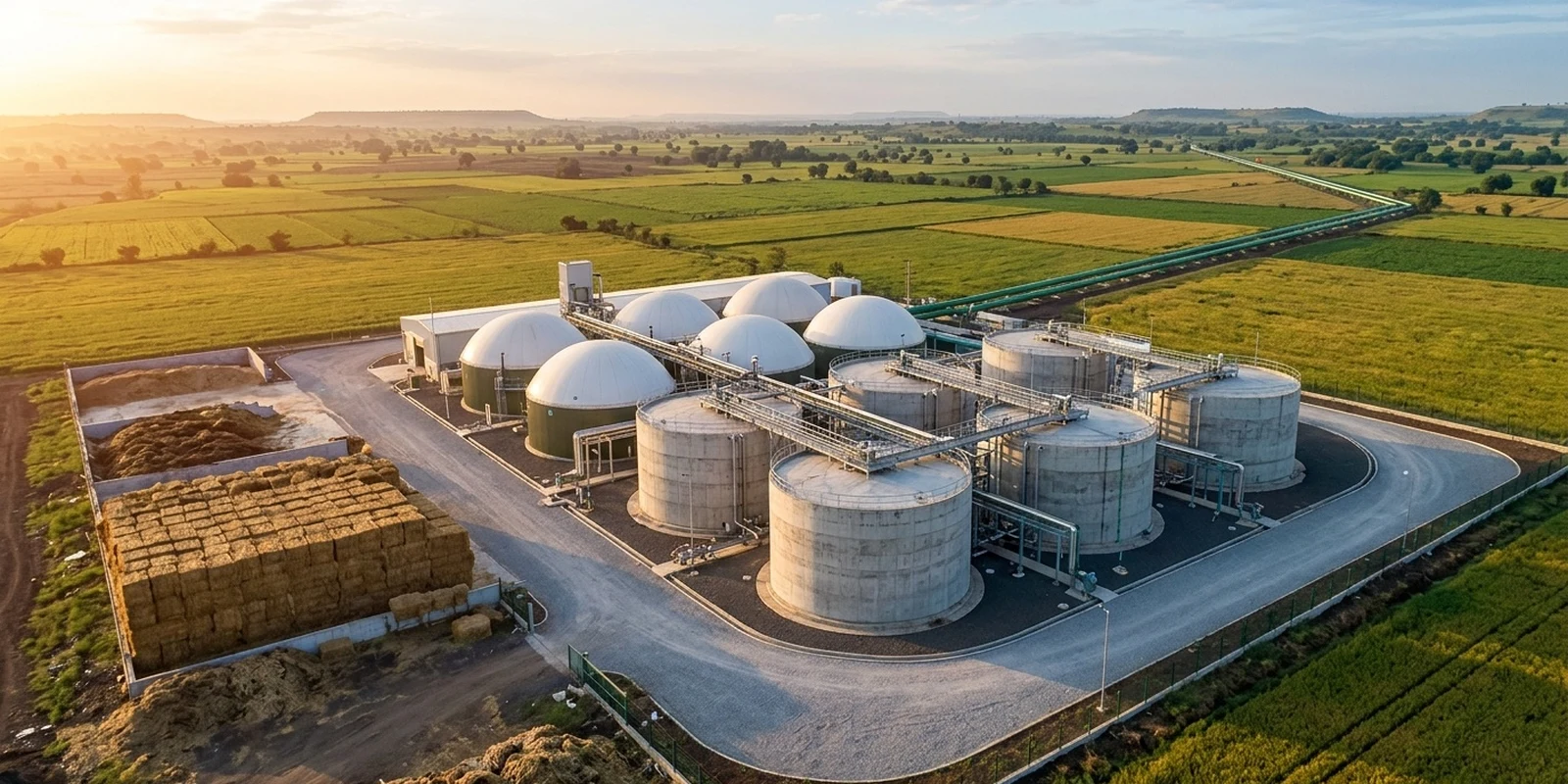
Compressed biogas is, in plain terms, natural gas grown rather than drilled. It’s produced by fermenting organic waste — cattle dung, crop residue, press mud, and municipal or kitchen waste — inside the oxygen-free digester tanks of a CBG plant, then purifying the resulting gas until it is chemically equivalent to fossil natural gas. That equivalence is what makes CBG a genuine substitute, not a niche alternative: it can be compressed, stored and pumped through the same CNG stations, PNG pipelines and gas-grid infrastructure India has already built — no new vehicles, no new stoves, no new pipeline standard required.
GOBARdhan — short for Galvanizing Organic Bio-Agro Resources Dhan — is the mechanism the government has built to make producing that gas, at scale, a viable business rather than a subsidised experiment. Approved for FY2026-27 through FY2035-36 and administered by the Ministry of Petroleum & Natural Gas, it replaces a CBG ecosystem that used to be split across four different ministries with one integrated national scheme covering offtake, pricing, capital, pipelines, credit and ecosystem-building.
Why Now: The Energy-Security Math Behind GOBARdhan
The PIB backgrounder accompanying the Cabinet decision is unusually direct about the strategic case. India meets close to half of its natural gas demand through imports, and nearly 55–60% of its LNG imports pass through the Strait of Hormuz — the narrow shipping lane between Iran and Oman that has repeatedly turned into a flashpoint during Gulf tensions. A scheme to grow domestic gas production, in that light, reads as much like a national-security document as an energy-transition one.
CBG doesn’t just cut emissions — it’s produced entirely onshore, from feedstock that exists wherever there are farms, dairies and cities, immune to the shipping-lane disruptions LNG cannot avoid. The backgrounder puts a number on that: reduced import dependence is projected to save more than ₹40,000 crore in foreign exchange over the scheme’s ten-year run — the case for a ₹23,731 crore commitment to what has, until now, been a small corner of India’s gas economy.
Inside GOBARdhan: The Six Growth Engines
GOBARdhan’s outlay isn’t a subsidy cheque so much as six interlocking guarantees designed to remove the specific risks that have kept CBG a cottage industry rather than a national one — demand, price, capital, evacuation, credit and execution risk, one apiece:
- Assured CBG Offtake — City Gas Distribution entities must blend CBG into CNG and PNG supply: 3% from FY2026-27, rising to 4% in FY2027-28 and 5% from FY2028-29 onward — turning a patchy market into a guaranteed demand floor.
- Stable Pricing — producers get a government-backed administered price of ₹2,110 per MMBTU (about ₹105/kg), locked in for a minimum of ten years, removing the biggest variable in a CBG project’s financial model.
- Capital Assistance — greenfield and brownfield plants can claim up to ₹2 crore per tonne-per-day (TPD) of installed capacity, covering digesters, feedstock-aggregation and manure equipment.
- Pipeline Infrastructure — funding for cluster-based and standalone pipeline connectivity to trunk gas lines and CGD networks, solving the “stranded gas” problem for plants with no economical way to sell beyond their locality.
- Credit Guarantee — a dedicated mechanism covers up to 85% of eligible loans for MSME-scale CBG projects, aimed at smaller developers and cooperatives who struggle to raise institutional finance.
- CBG Ecosystem Challenge Fund — a district-level fund for feedstock mapping, aggregation infrastructure and capacity building — the unglamorous groundwork every plant depends on.
Scaling An Existing Industry, Not Starting From Zero
GOBARdhan isn’t launching CBG production in India — it’s trying to take an already-real but small industry to national scale. According to the GOBARdhan Unified Registration Portal, 1,908 CBG and Bio-CNG plants were registered across the country as of 6 August 2026. Of those, 217 are already commissioned — together producing about 0.4 million standard cubic metres of gas a day — and another 339 are under construction.
That base didn’t appear overnight. GOBARdhan was first launched in 2018 under the Swachh Bharat Mission (Grameen) as a rural sanitation initiative before evolving into an energy programme. Since then, smaller schemes have done the groundwork this one now consolidates: the SATAT initiative that first opened CBG retail through fuel outlets; a ₹564.75 crore Biomass Aggregation Machinery Scheme (37 proposals, ₹248 crore disbursed); a ₹994.5 crore Pipeline Infrastructure Scheme; and a Market Development Assistance Scheme that has paid out ₹111.72 crore for organic fertiliser.
The problem those schemes exposed is exactly what GOBARdhan is built to fix: the CBG ecosystem was split across four different ministries, each running its own piece — feedstock, pipelines, pricing, fertiliser — with no single body accountable for whether a project actually got built. Folding all of it under the Ministry of Petroleum & Natural Gas is as much a governance reform as a funding one.
What It Means: India’s Third Biofuel-Blending Mandate
Zoom out, and GOBARdhan reads as the third leg of a strategy India has been building quietly, one fuel category at a time. Road transport got there first, with the ethanol-blending programme that pushed petrol to 20% ethanol content (E20) five years ahead of its original target. Aviation is next, with airlines preparing for a mandatory Sustainable Aviation Fuel blending mandate from January 2027 under the global CORSIA framework. GOBARdhan extends the same logic to piped and compressed gas — a fuel category that, unlike petrol or jet fuel, plugs directly into homes, stoves and gas-fired industry, not just vehicles.
The numbers behind the ₹23,731 crore outlay are substantial: CBG production growing ten-fold over the scheme’s ten-year run; more than ₹75,000 crore added to GDP; over 1.5 lakh jobs, mostly in rural India; 40+ million tonnes of CO₂ avoided by diverting organic waste from landfills; and 250 million tonnes of organic fertiliser produced as a byproduct, feeding back into the same farms that supplied the feedstock. Whether GOBARdhan hits those numbers depends on execution most CBG schemes haven’t managed at scale — but the design, for once, actually addresses the offtake, pricing and financing risks that stalled the industry’s first decade.
📄 Download: “GOBARdhan — Fuelling Clean Energy and Rural Growth”
The full 8-page PIB backgrounder covers all six growth engines, the schemes GOBARdhan consolidates, and the complete ten-year benefit projections — a useful primary-source reference for investors, developers and policy-watchers.
Download The Full Backgrounder (PDF)Frequently Asked Questions
What is GOBARdhan?
GOBARdhan (Galvanizing Organic Bio-Agro Resources Dhan) is India’s national scheme, approved by the Union Cabinet on 6 August 2026 with a ₹23,731 crore outlay, to scale up domestic production of Compressed Biogas (CBG) from organic and agricultural waste. It runs from FY2026-27 to FY2035-36 and is administered by the Ministry of Petroleum & Natural Gas.
What is compressed biogas (CBG), and is it the same as LPG or CNG?
CBG is biogas — produced by fermenting organic waste in oxygen-free digesters — that has been purified and compressed until it is chemically equivalent to natural gas. It isn’t the same as LPG (a petroleum byproduct) but is functionally interchangeable with CNG and PNG, so it can be sold and used through the same pumps, cylinders and pipelines.
How much will CBG cost under the new scheme?
GOBARdhan sets a government-backed administered price of ₹2,110 per MMBTU (roughly ₹105 per kilogram), guaranteed for a minimum of ten years for eligible producers.
What is the CBG blending obligation?
City Gas Distribution companies must ensure CBG makes up a rising share of the CNG and PNG they supply — 3% from FY2026-27, 4% from FY2027-28, and 5% from FY2028-29 onward — creating guaranteed demand for CBG producers.
How many CBG plants does India have today?
As of 6 August 2026, 1,908 CBG/Bio-CNG plants were registered on the GOBARdhan Unified Registration Portal, of which 217 are commissioned and 339 are under construction.
How does GOBARdhan improve India’s energy security?
India imports roughly half of its natural gas, and 55–60% of its LNG imports pass through the Strait of Hormuz. CBG is produced domestically, so scaling it up — GOBARdhan targets nearly ten-fold growth — directly reduces exposure to import disruptions and is projected to save over ₹40,000 crore in forex over ten years.
Source: Cabinet approves GOBARdhan | PIB Backgrounder: GOBARdhan — Fuelling Clean Energy and Rural Growth — Press Information Bureau, Government of India, 6 August 2026 (Release IDs 2295480, 2295738).