
PM-JANMAN Solar Electrification For Tribal Households
💡 PM-JANMAN Solar Electrification For Tribal Households: Key Highlights
- 1,38,620 PVTG households have been grid-electrified under PM-JANMAN — 99.6% of the 1,39,126-household target sanctioned across 13 states.
- 11,838 households have been electrified through off-grid solar where grid extension isn’t techno-economically feasible, against a 1-lakh-household target.
- Together, both tracks have brought power to roughly 1.5 lakh tribal and PVTG households so far.
- The off-grid solar component carries 100% Central Financial Assistance — up to ₹50,000 per household for a 0.3 kW system.
- ₹57.10 crore released for off-grid solar; ₹521.45 crore sanctioned (₹331.49 crore central) for the grid track.
- Run jointly under two flagship tribal-welfare missions: PM-JANMAN and DAJGUA.
For India’s Particularly Vulnerable Tribal Groups (PVTGs) and other tribal habitations, getting an electricity connection has historically meant waiting at the very back of the queue — villages tucked into forests and hill terrain where laying transmission lines costs far more than the households they’d serve can ever pay back. The Ministry of New and Renewable Energy’s PM-JANMAN solar electrification push for tribal households is now closing that gap through two parallel routes: extending the grid wherever it’s economically viable, and installing off-grid solar systems wherever it isn’t. Together, the two tracks have now reached roughly 1.5 lakh tribal households, according to a written reply presented in the Lok Sabha by Union Minister of State for New & Renewable Energy Shri Shripad Yesso Naik.
What Are PM-JANMAN And DAJGUA?
Both schemes are umbrella tribal-welfare missions that different ministries plug their own programmes into — solar electrification is just one component of each. PM-JANMAN (Pradhan Mantri Janjati Adivasi Nyaya Maha Abhiyan) was launched on 15 November 2023, timed to Janjatiya Gaurav Divas, with a ₹24,104 crore outlay (₹15,336 crore central, ₹8,768 crore state share) running through FY2025-26. It targets 75 PVTG communities spread across 18 states and the Andaman & Nicobar Islands, coordinated by the Ministry of Tribal Affairs alongside nine line ministries covering roads, housing, health and, in this case, power.
DAJGUA (Dharti Aaba Janjatiya Gram Utkarsh Abhiyan) is the broader successor campaign, launched a year later on 2 October 2024 from Hazaribag, Jharkhand, and named after the tribal leader Birsa Munda — revered as “Dharti Aaba,” or father of the earth. Its scope is far larger: 63,843 villages, more than 5 crore tribal citizens, 549 districts and 2,911 blocks across 30 states and Union Territories, with a combined outlay of ₹79,156 crore delivered through 25 interventions and 17 ministries. Electrification sits inside both missions because reliable power is a prerequisite for almost everything else they fund — schools, clinics, and small livelihoods.
A Two-Track Electrification Model: Grid Where Possible, Solar Where Not
The genuinely interesting policy design here isn’t the subsidy amount — it’s the decision to run two separate delivery mechanisms side by side, each suited to a different kind of village.
The Grid Track: 1.38 Lakh Households, Nearly Complete
Wherever extending the transmission network is technically and economically feasible, the Ministry of Power’s Revamped Distribution Sector Scheme (RDSS) foots the bill. Under this track, ₹521.45 crore has been sanctioned (of which ₹331.49 crore is central support) across 13 states to connect 1,39,126 PVTG households identified under PM-JANMAN to the regular grid. As of 24 July 2026, 1,38,620 of them — about 99.6% — are already connected, meaning this leg of the programme is effectively in its final stretch.
The Off-Grid Solar Track: Reaching The Last Mile
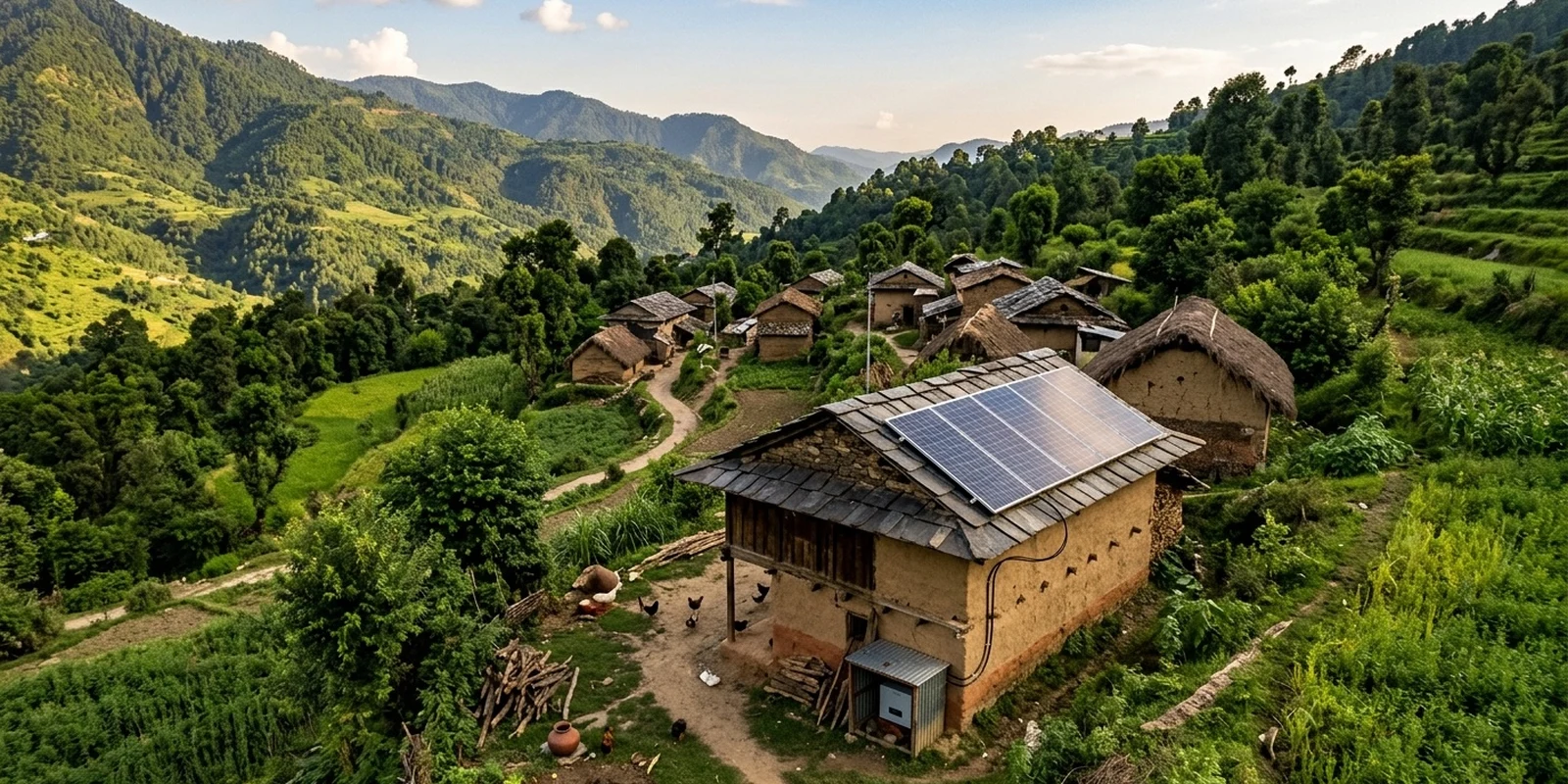
For households where grid extension simply doesn’t pencil out — a handful of homes scattered across a remote hillside, for instance — MNRE’s New Solar Power Scheme steps in with standalone 0.3 kW off-grid solar systems instead. This is the slower-moving but arguably more important track for last-mile access: as of 30 June 2026, 11,838 households have been electrified this way, against a scheme-wide target of 1 lakh un-electrified tribal and PVTG households, backed by ₹57.10 crore in Central Financial Assistance released so far.
Inside The New Solar Power Scheme’s 100% Subsidy Model
Every component of the off-grid solar scheme carries 100% Central Financial Assistance — tribal and PVTG households don’t co-pay any part of it, unlike general rooftop-solar schemes such as PM Surya Ghar’s rooftop solar push, where households still cover part of the installation cost even after subsidy.
| Component | What It Covers | Central Assistance |
|---|---|---|
| Household off-grid solar | 0.3 kW system per un-electrified household | ₹50,000/household, or actual cost, whichever is lower |
| Multi-Purpose Centre (MPC) lighting | Solar street lighting for community centres | ₹1 lakh per MPC |
| Public institution solarisation | Off-grid solar for schools, health centres, etc. in tribal habitations | ₹1 lakh/kW, up to 20 kW capacity |
The scheme’s boundaries are also explicit: it doesn’t extend to commercial premises. The government has confirmed that no subsidy currently exists, or is under consideration, for small shopkeepers to install solar panels under this route — it’s strictly a household and public-institution programme.
Powering More Than Homes: Multi-Purpose Centres And Public Institutions
Household connections are only part of the plan. The scheme also targets solar street lighting for 1,500 Multi-Purpose Centres — the community halls that double up as meeting spaces, ration points and informal health outposts in tribal habitations — plus off-grid solarisation of schools, health sub-centres and other public institutions, at up to 20 kW per site. A lit MPC after dark, or a health centre that can refrigerate medicines and run basic equipment, often changes daily life in a tribal habitation more visibly than a single household connection does, since it serves an entire settlement rather than one family.
What It Means
This is a smaller, quieter story than India’s renewable capacity headlines, but arguably a more consequential one for the households it touches. India’s broader renewable capacity growth has been driven overwhelmingly by utility-scale solar parks and rooftop schemes in accessible geographies; PM-JANMAN’s solar electrification effort is aimed squarely at the geographies those programmes structurally can’t reach. The two-track design — grid where the economics work, solar where they don’t — is a pragmatic admission that a single technology can’t solve universal electrification on its own. With the grid track nearly complete at 99.6% of its target, the off-grid solar track (just under 12% of its 1-lakh-household goal) is now the one to watch: it’s the harder, slower work of reaching the households the grid was never going to reach economically, and its pace over the next few years will determine how quickly “last-mile” stops being a euphemism for “left behind.”
Frequently Asked Questions
What is PM-JANMAN and who does it help?
PM-JANMAN (Pradhan Mantri Janjati Adivasi Nyaya Maha Abhiyan) is a ₹24,104 crore central mission launched in November 2023 to improve infrastructure and welfare for 75 Particularly Vulnerable Tribal Groups (PVTGs) across 18 states and the Andaman & Nicobar Islands, including housing, roads, health, education, and electrification.
What is DAJGUA and how is it different from PM-JANMAN?
DAJGUA (Dharti Aaba Janjatiya Gram Utkarsh Abhiyan) is a larger, later tribal-development campaign launched in October 2024, covering 63,843 villages and over 5 crore tribal citizens nationwide with a ₹79,156 crore outlay. PM-JANMAN focuses narrowly on the most vulnerable PVTG communities; DAJGUA covers a much wider tribal population through 25 interventions across 17 ministries.
How many tribal households have been electrified so far?
Roughly 1.5 lakh households combined: 1,38,620 PVTG households connected to the grid under the Revamped Distribution Sector Scheme (as of 24 July 2026), and 11,838 households electrified via off-grid solar systems (as of 30 June 2026).
Why do some tribal households get grid power and others get solar?
The choice depends on cost and feasibility. Where extending transmission lines is technically and economically viable, the household is connected to the regular grid under RDSS. Where it isn’t — typically remote, scattered hill or forest habitations — the household instead gets a standalone 0.3 kW off-grid solar system under MNRE’s New Solar Power Scheme.
How much does the government subsidise for off-grid solar systems?
100% Central Financial Assistance. A household off-grid solar system is subsidised at ₹50,000 or the actual cost, whichever is lower; Multi-Purpose Centre lighting at ₹1 lakh per centre; and public institution solarisation at ₹1 lakh per kW, up to 20 kW.
What is a Multi-Purpose Centre and why is it being solarised?
A Multi-Purpose Centre (MPC) is a community facility in tribal habitations that serves as a meeting space, ration point and informal health outpost. The scheme targets solar street lighting for 1,500 MPCs so these shared spaces can function after dark, benefiting an entire settlement rather than a single household.
Source: Press Information Bureau — Ministry of New & Renewable Energy, Lok Sabha written reply, 30 Jul 2026 (PRID 2291540). Background: MNRE – PM-JANMAN.