

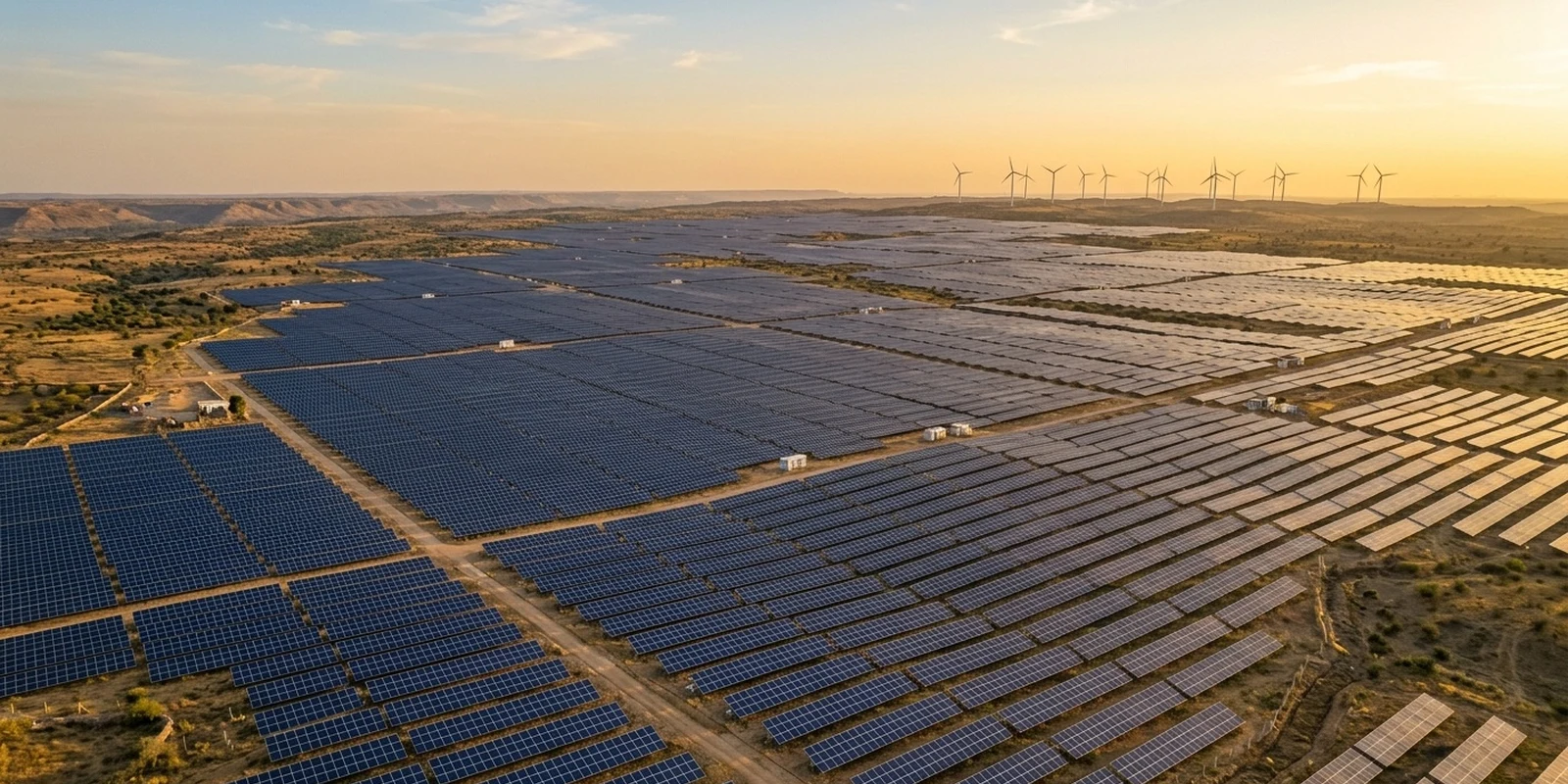
India Crosses 300 GW Of Non-Fossil Power Capacity
💡 India Non-Fossil Power Capacity 300 GW: Key Highlights
- India’s non-fossil power capacity crossed 300 GW for the first time on 31 July 2026, reaching 300.50 GW.
- That’s over 60% of the way to the 500 GW non-fossil target India has committed to for 2030.
- Solar now leads the mix at 164.59 GW, ahead of wind (58.14 GW), hydro (57.24 GW), bio-power (11.75 GW) and nuclear (8.78 GW).
- Non-fossil sources now supply more than 54% of India’s roughly 552 GW total installed power capacity.
- FY2025-26 alone added a record 55.29 GW of non-fossil capacity — 44.6 GW of it solar.
- Domestic solar module manufacturing enlisted under the ALMM list has crossed 200 GW, up from just 2.3 GW in 2014.
India’s non-fossil power capacity has crossed a threshold the country had never touched before: 300 GW, as of 31 July 2026. MNRE confirmed the number on 9 August 2026 — 300.50 GW of combined solar, wind, hydro, bio-power and nuclear capacity, putting India more than 60% of the way to the 500 GW non-fossil target it has committed to for 2030.
For the fuller financing picture, see our earlier coverage of India’s renewable capacity and the $45.72 billion in FDI funding behind it; for the climate-policy angle, see our piece on India’s NDC-linked target of 60% non-fossil capacity by 2035. This piece covers what’s changed since, plus a second milestone in the same release: domestic solar manufacturing crossing 200 GW.
India Non-Fossil Power Capacity Crosses 300 GW For The First Time
“Non-fossil capacity” is everything on India’s grid that isn’t coal, gas or diesel: solar, wind, hydro, bio-power and nuclear together. As of 31 July 2026, that combined capacity stood at 300.50 GW — never crossed before. India added a record 55.29 GW of non-fossil capacity in FY2025-26 alone, and non-fossil sources now make up over 54% of the country’s roughly 552 GW of total installed power capacity.
Source-Wise Breakdown: Solar Now Leads At 164.59 GW
MNRE’s 31 July 2026 breakdown shows solar has pulled decisively ahead of every other non-fossil source:
| Source | Capacity (GW) | Share of non-fossil total |
|---|---|---|
| Solar | 164.59 | ~54.8% |
| Wind | 58.14 | ~19.3% |
| Hydro (large & small) | 57.24 | ~19.1% |
| Bio-power | 11.75 | ~3.9% |
| Nuclear | 8.78 | ~2.9% |
| Total non-fossil | 300.50 | 100% |
The growth curve is steep: solar has gone from 2.8 GW in 2014 to 164.59 GW today, and wind has almost tripled to 58.14 GW. Generation kept pace too — renewable output rose from 190.96 to 477.79 billion units between FY2014-15 and FY2025-26.
What’s Changed Since Our Last Capacity Update
A month earlier, on 30 June 2026, India’s non-fossil capacity stood at 297.36 GW — the figure in our June update. Solar added roughly 2.4 GW and wind about 0.7 GW since then, pushing the total past 300 GW for the first time. That June figure, and the separate 54.18% non-fossil-share number, both came from parliamentary replies; this release is a direct MNRE statement with its own breakdown and a previously unreported manufacturing milestone — new ground, not a restatement.
The Other Big Number: Domestic Solar Manufacturing Tops 200 GW
Buried in the same release is a milestone that matters just as much: capacity enlisted under the Approved List of Models and Manufacturers (ALMM) for solar PV modules has crossed 200 GW, up from 2.3 GW in 2014. The ALMM decides which domestically made modules qualify for government-linked projects — backed by the PLI scheme, it has pulled India’s module-making capacity past the country’s entire installed solar base of 164.59 GW.
That’s an import-substitution story as much as a manufacturing one: India built its early solar boom largely on imported cells and modules, and a domestic base this size cuts that exposure. It mirrors a broader push across India’s clean-energy supply chain — we covered a similar dynamic in grid-scale battery storage, where a Ministry of Heavy Industries tender for 10 GWh of stationary storage manufacturing targets grid batteries rather than EV packs. MNRE frames both threads — solar manufacturing and the National Green Hydrogen Mission — as central to energy independence, not just emissions targets.
What It Means
The Pace To 500 GW
India needs roughly 199.5 GW more to reach 500 GW by 2030. At the FY2025-26 rate of 55.29 GW a year, that gap closes in about 3.6 years — inside the 2030 window, but only if the pace holds.
What 200 GW Of Domestic Manufacturing Buys India
A domestic ALMM base of 200-plus GW — bigger than India’s installed solar fleet — signals module supply is no longer the bottleneck it once was, though assembly still leans on imported cells and polysilicon upstream. For a country adding tens of gigawatts of solar a year, that’s one fewer point of failure.
Frequently Asked Questions
What is India’s non-fossil power capacity as of July 2026?
300.50 GW as of 31 July 2026 — the first time India has crossed 300 GW of combined solar, wind, hydro, bio-power and nuclear capacity, per MNRE.
How much of India’s non-fossil capacity is solar?
164.59 GW, about 55% of the non-fossil total — the single largest source, ahead of wind (58.14 GW) and hydro (57.24 GW).
What is India’s 500 GW non-fossil target for 2030?
India has committed to 500 GW of non-fossil electricity capacity by 2030. At 300.50 GW, it is over 60% of the way there.
What is the ALMM list and why does it matter?
The Approved List of Models and Manufacturers (ALMM) is a government registry of domestically made solar PV modules eligible for government-linked projects. Capacity on it has crossed 200 GW, up from 2.3 GW in 2014, reflecting India’s push to manufacture modules domestically under the PLI scheme.
Source: Press Information Bureau — Ministry of New and Renewable Energy, 9 August 2026 (Release ID 2296782).