India Pumped Storage Hydropower Capacity: The CEA Path From 7.43 GW To 105.56 GW By 2036
India pumped storage hydropower capacity is 7.43 GW today. CEA maps a path to 105.56 GW by 2035-36: the pipeline, regional map and closed-loop shift.

India’s 100 GW Pumped Storage Buildout
- 7.43 GW operating across 10 projects (August 2026); India ranks fourth in the world.
- 105.56 GW by 2035-36 on the CEA pathway: about 14 times today’s fleet (derived).
- 33.70 GW is visible today (operating, under construction or CEA-cleared); roughly 72 GW still has to enter the pipeline (derived).
- 345.38 GW identified potential across 320 sites, 84% of it off-stream, away from rivers (derived share).
- Since 19 October: a Rs 14,500 crore VGF scheme earmarks 60 GWh for pumped storage.
India’s pumped storage hydropower capacity stands at 7.43 GW, and the Central Electricity Authority (CEA) has mapped a path that would take it to 105.56 GW by 2035-36. That is the core of a PIB backgrounder published on 19 October 2026 on the national pipeline, regional sites and policy support. Four weeks on, the numbers hold and two new developments firm them up.
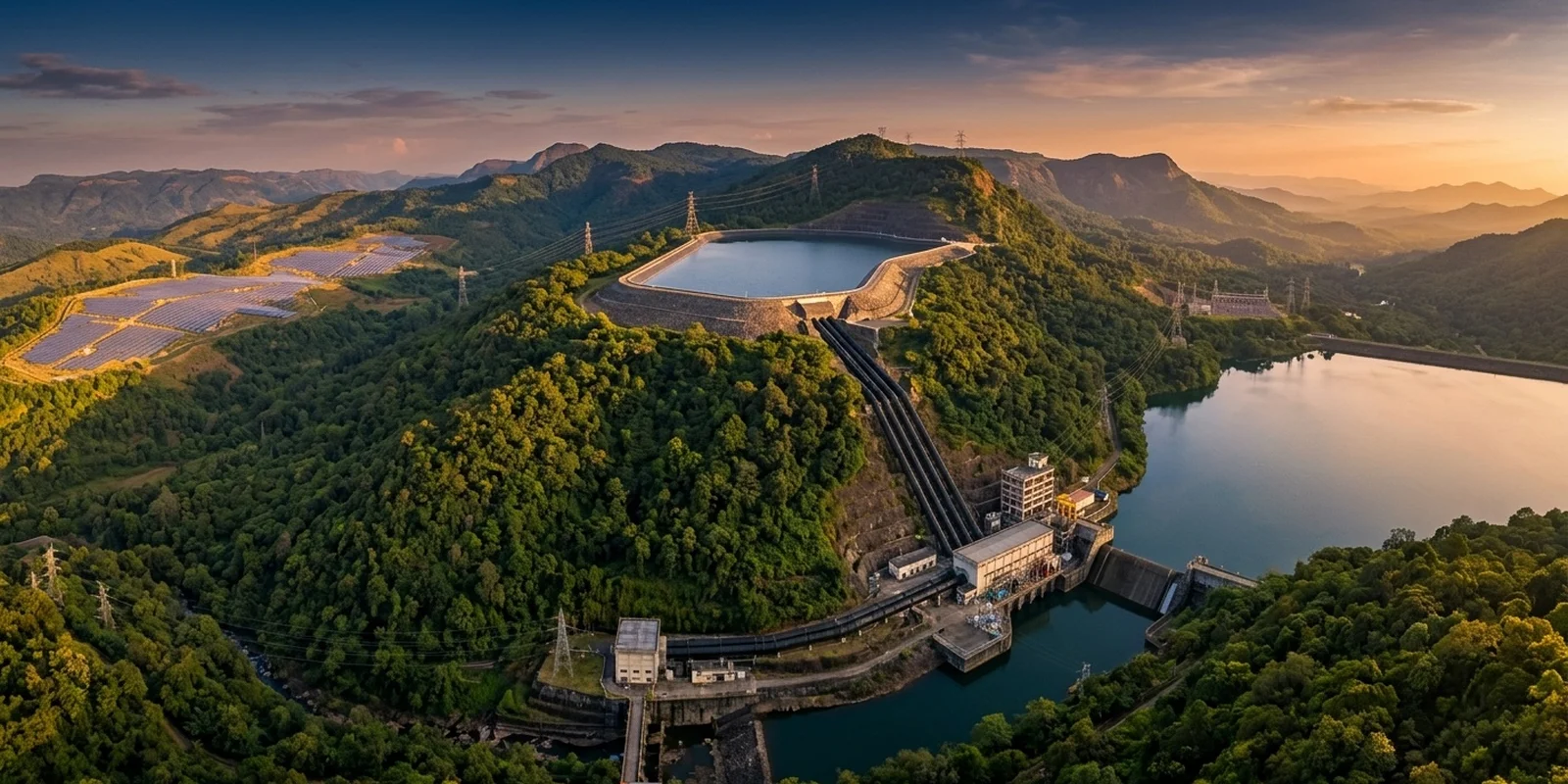
Pumped storage is a water battery: it pumps water uphill when power is plentiful, usually at the midday solar peak, and releases it through turbines when demand rises. With India past 300 GW of non-fossil capacity, the question is no longer whether the grid needs storage, but how much and of what kind.
The CEA Pathway For India Pumped Storage Hydropower Capacity
The CEA envisages 100.81 GW of pumped storage projects (PSPs) being commissioned between 2025-26 and 2035-36, including projects already under construction. Added to the base, that takes cumulative capacity to 105.56 GW, roughly 14 times today’s fleet (derived).
The pathway is back-loaded. Only 2.92 GW is due in 2026-27 and 1.6 GW in 2027-28, while 2029-30 and 2030-31 carry 34.69 GW between them, about a third of the decade’s additions (derived). India would need about 9.8 GW a year from 2026-27, against 2.68 GW added in 2025-26 (derived).
| Year | Addition (GW) | Cumulative (GW) |
|---|---|---|
| 2025-26 | 2.68 | 7.43 |
| 2026-27 | 2.92 | 10.35 |
| 2027-28 | 1.60 | 11.95 |
| 2028-29 | 6.35 | 18.30 |
| 2029-30 | 13.50 | 31.80 |
| 2030-31 | 21.19 | 52.99 |
| 2031-32 | 8.80 | 61.79 |
| 2032-33 | 14.59 | 76.38 |
| 2033-34 | 11.88 | 88.26 |
| 2034-35 | 5.70 | 93.96 |
| 2035-36 | 11.60 | 105.56 |
CEA pumped storage pathway, PIB backgrounder, 19 October 2026 (rounded).
The pathway also runs well ahead of older planning numbers. By 2031-32 it reaches 61.79 GW, against the 26.69 GW pumped storage requirement in the National Electricity Plan that we covered in our breakdown of India’s BESS and pumped storage targets for 2031.
The Pipeline: What Exists And What Is Still On Paper
The backgrounder splits the current pipeline into three stages, as of August 2026:
- Operational: 7.43 GW across 10 projects, each above 25 MW.
- Under construction or implementation: 15.87 GW across 11 projects.
- Concurred or appraised by the CEA: 10.40 GW across 8 projects.
That is 33.70 GW with a site attached (derived). Taking India’s pumped storage hydropower capacity to 105.56 GW means roughly 72 GW of projects still has to be surveyed, approved and financed (derived). Since these plants take several years to build, the projects behind the 2030-31 peak must reach approval within the next two to three years.
Where The Water Batteries Can Go
India has identified 320 pumped storage sites with a combined potential of 345.38 GW. The 2035-36 pathway would use about 31% of it (derived). Geography decides where it sits, because each project needs two reservoirs at very different heights:
- Western Region, 129.72 GW: the steep rivers of the Western Ghats make it the richest. Maharashtra alone has 67.36 GW and Gujarat 33.36 GW.
- Southern Region, 97.76 GW: led by Andhra Pradesh, Telangana and Tamil Nadu.
- Eastern Region, 53.41 GW: Odisha accounts for 41.53 GW.
- Northern Region, 50.32 GW: led by Uttar Pradesh and Himachal Pradesh.
- North-Eastern Region, 14.18 GW.
The West and South together hold about two-thirds of the potential (derived), close to several of India’s largest solar and wind zones.
Why Off-Stream And Closed-Loop Projects Are Favoured
The backgrounder sorts projects into three designs. On-stream schemes have both reservoirs on a river, stream or nallah. Off-stream open-loop schemes have one reservoir on a watercourse. Off-stream closed-loop schemes have neither on a perennial watercourse; water is filled once and cycled between the two.
Of the 345.38 GW potential, 288.71 GW across 258 sites is off-stream, about 84% (derived). The government is favouring them because they build faster and disturb river ecology less, and the rules now reflect that: closed-loop schemes are exempt from CEA concurrence whatever their capital cost, CEA review of project reports is down from 90 to 50 days, and projects awarded by 30 June 2028 get a 100% inter-state transmission charge waiver for 25 years.
What Has Changed Since The Backgrounder
The biggest change is money. On 4 November the Union Cabinet approved a Rs 14,500 crore viability gap funding scheme for 92 GWh of new grid-scale storage, of which 60 GWh, about 65%, is earmarked for pumped storage (derived share). Capacity goes out through tariff-based competitive bidding; we explain the scheme in our post on India’s grid-scale energy storage VGF scheme.
At state level, Odisha’s cabinet approved the 600 MW Upper Indravati pumped storage project in Kalahandi district on 9 November, at an estimated Rs 4,708.64 crore. It is reported as the state’s first large-scale project, in a state with 41.53 GW of identified potential.
What It Means For The Energy Transition
Batteries and pumped storage do different jobs. Batteries respond fast, install in months and sit close to load. Pumped storage moves large volumes of energy over many hours and runs for decades, but needs the right terrain. A solar-heavy grid needs both.
The 105.56 GW figure is a plan, not a commitment; it depends on the next three years of approvals and on how quickly VGF bids clear. Delivered, it would give India one of the world’s largest pumped storage fleets, built alongside the 500 GW of new clean power India wants to add over the next decade.
Grid storage is half the picture. EV charging is becoming one of the most flexible loads on the network, because chargers can shift demand into hours of surplus power. Coordinating storage, flexible demand and distributed energy is the idea behind Yellow Haze’s virtual power plant capabilities, which link clean generation with e-mobility demand across our product companies.
Frequently Asked Questions
What is India’s pumped storage hydropower capacity today?
7.43 GW across 10 projects as of August 2026, fourth in the world behind China, Japan and the United States.
How much pumped storage does India plan to build by 2036?
The CEA envisages 100.81 GW of commissioning between 2025-26 and 2035-36, taking cumulative capacity to 105.56 GW.
What is closed-loop pumped storage?
A design in which neither reservoir sits on a perennial river or stream, so water cycles between two purpose-built reservoirs. India exempts these schemes from CEA concurrence regardless of capital cost.
Which Indian states have the most pumped storage potential?
Of the state figures the backgrounder gives, Maharashtra (67.36 GW), Odisha (41.53 GW) and Gujarat (33.36 GW) are the largest. Southern states are not broken out.
Pumped storage shifts power across hours at grid scale. EV chargers can shift demand the same way, closer to the consumer.
Explore YoCharge smart chargingSource: PIB Backgrounder “Pumped Storage Hydropower” — PIB Delhi, 19 October 2026 (PRID 2324992) | VGF Scheme for Grid-Scale Energy Storage — Union Cabinet, 4 November 2026 (PRID 2332474).