Agrivoltaics Potential In India: 30% Of Cropland Is Solar-Suitable, But Farms Average 0.96 Hectares
Agrivoltaics potential in India spans 47.5 million hectares, about 30% of cropland. What the Delhi world conference said it takes on 0.96-ha farms.

One Land, Two Harvests: Can India’s Small Farms Carry Solar?
💡 Agrivoltaics Potential In India: Key Highlights
- 47.5 million hectares, about 30% of India’s cropland, is technically suitable for agrivoltaics (TERI study cited by MNRE).
- The binding constraint is farm size: the average landholding is 0.96 hectares.
- Elevated structures cost 25–30% more than ground-mounted solar; PM-KUSUM’s next phase is meant to close the gap.
- Odisha’s draft Agrivoltaics Policy 2026 targets 1 GW by 2030, with 90% of each site kept cultivable.
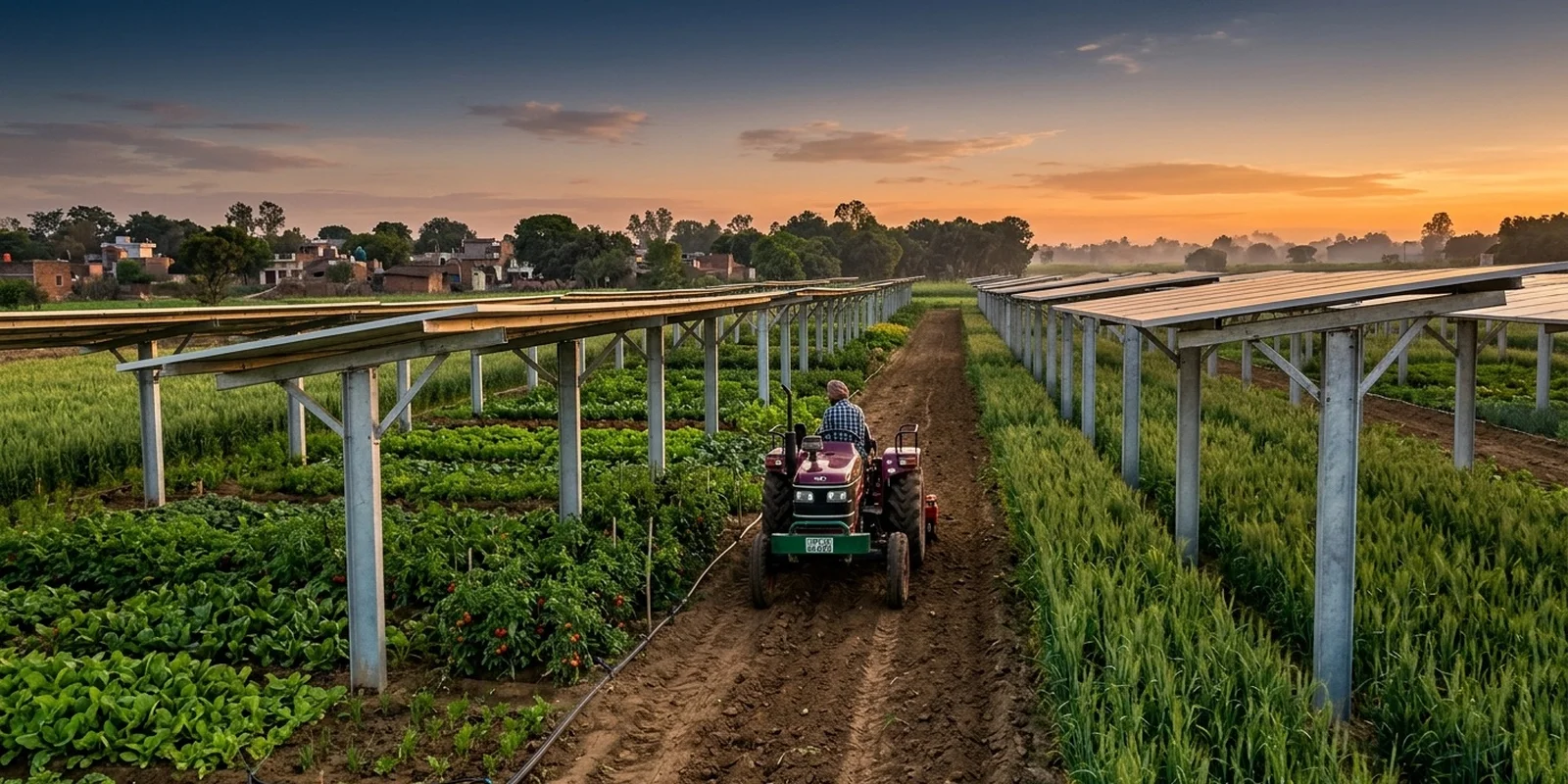
The 7th AgriVoltaics World Conference (Bharat Mandapam, New Delhi, 21–23 October 2026) put one large number at the centre of India’s clean-energy debate: the agrivoltaics potential in India covers roughly 30% of the country’s cropland. Held in the Global South for the first time, it was opened jointly by Agriculture Minister Shivraj Singh Chouhan and Renewable Energy Minister Pralhad Joshi, a fitting pairing: agrivoltaics, raising solar panels high enough that crops keep growing underneath, only works if energy and farm policy are written together.
We covered the curtain-raiser in September, when MNRE first framed agrivoltaics as three income streams for farmers under PM-KUSUM’s next phase. This follow-up covers what the conference added: the national estimate, the Agriculture Ministry’s design conditions, the cost gap and the first state pitches to investors.
Agrivoltaics Potential In India, By The Numbers
Joshi cited a study by The Energy and Resources Institute (TERI) estimating that 47.5 million hectares are technically suitable for agrivoltaics, about 30% of India’s 160 million hectares of cropland. Maharashtra, Rajasthan, Andhra Pradesh, Madhya Pradesh, Karnataka and Uttar Pradesh together account for nearly half of it.
The headline scenario is larger still. Covering 16 million hectares could generate an estimated 12,775 TWh a year, against projected 2050 demand of 5,250–10,020 TWh. By our calculation, that is a tenth of all cropland producing 1.3 to 2.4 times the demand range. Joshi called these technical estimates dependent on local feasibility: they describe what the land could hold, not what will be built.
For scale, India’s non-fossil capacity is 308.03 GW, over 55% of about 560 GW installed. Agrivoltaics is pitched as the next pool of land for that build-out: “one land, two harvests.”
The 0.96-Hectare Design Rules
Chouhan’s keynote supplied the counterweight. The average Indian landholding is 0.96 hectares (about 2.4 acres, our conversion) and more than 85% of farmers are small or marginal. They cannot take land out of cultivation and invest their own money. Farmers should become “annadatas and urjadatas”, providers of food and energy, but only on terms that never interrupt farming. His checklist:
- Clearance for machinery. Panel height and spacing must allow ploughing and let farmers change crops each year.
- Water management. Runoff from panels must be drained and harvested to prevent soil erosion.
- Bankable offtake. Reliable power purchase, grid connection and timely payment to farmers.
- Exit safeguards. No burden on farmers if a developer abandons a project or panels are removed at contract end.
- Local ownership of the work. Farmer Producer Organisations (FPOs) involved, and rural youth and women trained in operation and maintenance.
The exit clause matters most to financiers: with 25-year contracts, developer-funded decommissioning is a real cost investors will price in.
The Cost Gap And Who Closes It
Joshi said elevated, tilted structures make agrivoltaic plants 25–30% more expensive than ground-mounted solar. Against that: the average cost of power supply in 2025–26 was about ₹7 per unit, while some assessments put agrivoltaic generation at ₹3.20–3.30 per unit under specific assumptions. Field studies also indicate 10–20% higher yields for certain crops and around 30% lower water use under suitable systems.
The government’s answer is the next phase of PM-KUSUM, which Joshi said will carry “one of the world’s most ambitious” agrivoltaic programmes and support AgriPV capacity directly. The scheme has solarised 25–30 lakh pumps so far (the MNRE Secretary cited about 25 lakh, the minister 30 lakh). On Day 2, the World Bank, KfW, the European Investment Bank and IREDA discussed concessional and blended finance.
Abroad, global agrivoltaic capacity passed 18.4 GW in 2025. Italy runs a €1.7 billion programme and Germany ties support to minimum crop yields.
States Make Their Pitch
On Day 2, ministers from Odisha, Madhya Pradesh, Uttar Pradesh, Rajasthan and Bihar presented in a track co-organised by IISD and CEEW. Farm power and land records sit with states, so this is where deployment gets decided.
Odisha: the most complete policy on the table
Deputy Chief Minister Kanak Vardhan Singh Deo said Odisha is finalising an Agrivoltaics Policy 2026 targeting 1 GW by 2030. At least 90% of each site must stay cultivable, with farmer consent and crop insurance safeguarded; farmers can own projects or lease land while still farming. Investors get 25-year PPAs with GRIDCO, an offtake guarantee and grid connectivity.
Uttar Pradesh, Madhya Pradesh and Bihar: grid-side groundwork
Uttar Pradesh plans to solarise all 16 lakh farm tubewells whose bills are waived, with Green Energy Corridor-III strengthening evacuation; its ministers assured that land ownership stays with farmers. Madhya Pradesh reported cultivation under panels at several sites and a completed battery-storage tender, the kind of capacity India’s ₹14,500 crore grid-storage VGF scheme now funds nationally. Bihar is solarising about 2,700 agricultural feeders with state funding. Rajasthan attended without a recorded announcement.
What Has To Be Solved Before Agrivoltaics Potential In India Becomes Capacity
The gap between 47.5 million suitable hectares and a handful of pilot sites is still wide. In our reading, four problems come first.
- Land rights and contracts. Odisha’s own-or-lease model and Chouhan’s exit safeguards need to become national standard terms.
- Technical standards. The Global Agrivoltaics Climate-Zone Technical Framework launched at the conference and ICAR-IWMI agro-climatic zoning are a start; developers still need national rules on height, spacing and yield thresholds.
- Financing small sites. A 25–30% premium on sub-hectare plots needs aggregation through FPOs or cooperatives to reach bankable size.
- Offtake and grid coordination. MNRE is developing procurement models with DISCOMs, and Joshi proposed siting plants near mandis and cold chains using 7.70 lakh geo-tagged rural facilities.
Thousands of small farm plants add up to a distributed generation fleet; coordinating them is the job of a virtual power plant. Farmers selling surplus daytime power locally is the model behind peer-to-peer energy trading as an alternative to net metering. For India’s next 500 GW of non-fossil capacity, agrivoltaics offers land without taking farms out of production, if market rules for small generators keep up. France hosts the 8th conference in 2027; the test before then is whether PM-KUSUM’s next phase and Odisha’s policy are notified.
Frequently Asked Questions
What is the agrivoltaics potential in India?
A TERI study cited by MNRE estimates 47.5 million hectares, about 30% of India’s 160 million hectares of cropland, are technically suitable, with Maharashtra, Rajasthan, Andhra Pradesh, Madhya Pradesh, Karnataka and Uttar Pradesh holding about half. These are technical estimates, not forecasts.
Does agrivoltaics reduce crop yields?
Not necessarily. Field studies cited at the conference indicate 10–20% higher yields for certain crops and about 30% lower water use under suitable systems; results vary by crop, climate zone and layout.
Why are agrivoltaic plants more expensive than normal solar farms?
Panels sit higher and wider apart so machinery can work beneath, adding 25–30% to cost, per MNRE. PM-KUSUM’s next phase is meant to close that gap.
Do farmers lose ownership of their land in agrivoltaic projects?
Under the models discussed, no. Odisha’s draft policy lets farmers own projects or lease land while cultivating, and Uttar Pradesh stated ownership remains protected.
Source: AgriVoltaics World Conference 2026 inauguration — Ministry of New and Renewable Energy, 21 Oct 2026 (PRID 2326059) | Agriculture Minister’s keynote — PIB Delhi, 21 Oct 2026 (PRID 2326152) | Day 2 highlights — MNRE, 22 Oct 2026 (PRID 2326832) | Closing session — MNRE, 23 Oct 2026 (PRID 2327649).