India’s Solar Sector Has Grown 62x To 175 GW: The Backgrounder That Explains How
India solar energy capacity grew 62-fold to 175 GW by October 2026. PIB traces the five-pillar framework behind the record 44.61 GW added in FY 2025-26.


India’s Solar Sector Has Grown 62x To 175 GW
- India solar energy capacity grew 62-fold from 2.82 GW in 2014 to approximately 175 GW by 31 October 2026 (stated by PIB).
- Record 44.61 GW of solar added in FY 2025-26, nearly double the 23.83 GW in FY 2024-25 (stated by PIB).
- India surpassed the USA in annual solar additions in calendar year 2025: 37 GW against 34 GW (stated by PIB).
- Solar module manufacturing capacity rose from 2.3 GW (2014) to 192 GW by June 2026 (stated by PIB).
- PM Surya Ghar has enrolled 65 lakh households, with 21+ lakh now reporting zero electricity bills (stated by PIB).
- Non-fossil capacity reached 308.03 GW as of September 2026; renewables met 51.5% of demand on 29 July 2025 (stated by PIB).
India solar energy capacity has grown 62-fold in a decade. From 2.82 GW in 2014 to approximately 175 GW as of 31 October 2026, the country added more solar power in FY 2025-26 alone — a record 44.61 GW — than it had installed in total seven years ago. A PIB backgrounder released on 17 November 2026 traces the five-pillar policy framework behind this expansion. Here is what the numbers show and why they matter.
Record Additions And The USA Comparison
India added 44.61 GW of solar capacity in FY 2025-26, nearly double the 23.83 GW installed in FY 2024-25, according to the backgrounder. In calendar year 2025, India added 37 GW of solar capacity against 34 GW by the United States, making it the world’s second-largest solar growth market behind China, as stated by PIB. Additions in FY 2026-27 had already reached 24.29 GW as of October 2026, keeping the trajectory steep.
Capacity Breakdown And Non-Fossil Totals
Of the approximately 175 GW installed by October 2026, large-scale solar projects account for 133 GW, grid-connected rooftop systems for 34.97 GW, and off-grid installations for the remainder, as stated in the backgrounder.
India’s total non-fossil-fuel power capacity, which includes wind, hydro, biomass and nuclear alongside solar, stood at 308.03 GW as of 30 September 2026, comprising 299.25 GW of renewable energy and 8.78 GW of nuclear capacity, as stated by PIB. Renewable sources met 51.5 per cent of the country’s electricity demand on 29 July 2025, the highest share recorded on a single day, according to the backgrounder. For a broader view of India’s 500 GW non-fossil capacity push, see our coverage of the Bharat Renewable Energy Summit.
The Five-Pillar Policy Framework
The backgrounder frames the expansion around five pillars.
Pillar 1: Vision And Climate Commitments
Under the Panchamrit pledges announced at COP26 in Glasgow, India committed to reaching 500 GW of non-fossil-fuel power capacity by 2030 and achieving net-zero emissions by 2070. Solar is the largest contributor, supplying more capacity than any other single source in the renewable mix. India also co-founded the International Solar Alliance (ISA) with France at COP21 in 2015 to promote solar deployment across member nations.
Pillar 2: Demand Creation Through RPOs, PM Surya Ghar And PM-KUSUM
The government has used Renewable Purchase Obligations (RPOs), which require distribution companies to source a rising share of power from renewables, to create structural demand. The RPO target for FY 2026-27 stands at 35.95 per cent, with a trajectory notified through 2029-30, as stated in the backgrounder.
Two large-scale programmes anchor the residential and agricultural segments. PM Surya Ghar Muft Bijli Yojana, the rooftop solar subsidy scheme with an outlay of Rs 75,021 crore, has enrolled 65 lakh households as of November 2026, with more than 21 lakh households now reporting zero electricity bills, as stated by PIB. PM-KUSUM, targeting 34,800 MW of decentralised solar capacity by FY 2026-27 with Rs 34,422 crore in central financial support, had installed 11.91 lakh standalone off-grid solar pumps and covered 17.18 lakh pumps under feeder-level solarisation as of 30 September 2026, benefiting 21.77 lakh farmers as of 31 December 2025, according to the backgrounder.
Distributed solar as a category, combining PM-KUSUM and rooftop installations, contributed 16.3 GW of the record 44.61 GW added in FY 2025-26, or 36 per cent of the total, as stated by PIB.
Pillar 3: Cost Discovery Through Competitive Bidding
Competitive bidding drove solar tariffs from approximately Rs 18 per unit in 2010 down to a record Rs 1.99 per unit by Gujarat Urja Vikas Nigam Limited in 2020, according to the backgrounder. India’s levelised cost of solar electricity stood at USD 35 per MWh in 2025, below the global average of USD 44 per MWh, as stated by PIB.
Domestic Manufacturing: From 2.3 GW To 192 GW
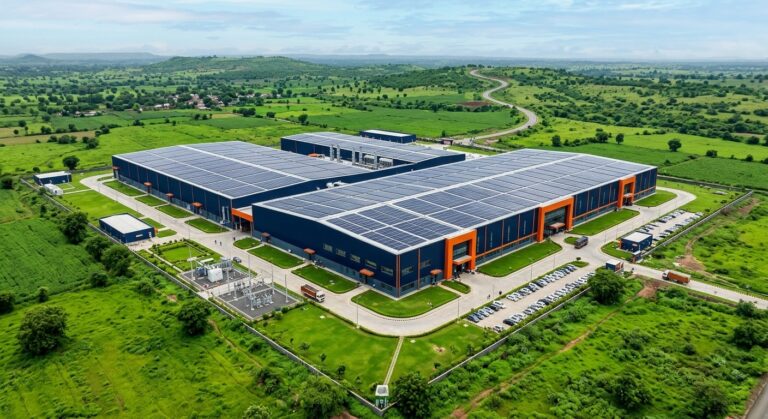
The backgrounder dedicates significant attention to its fourth pillar: domestic manufacturing. India’s solar PV module manufacturing capacity has grown from 2.3 GW in 2014 to 192 GW by June 2026 — an 83-fold increase (Derived: 192 / 2.3) — as stated by PIB. The expansion has been backed by the Production Linked Incentive (PLI) scheme, initially approved with an outlay of Rs 4,500 crore in 2021 and expanded by Rs 19,500 crore in 2022. By October 2024, the PLI scheme had attracted approximately Rs 35,000 crore in investments and generated around 10,000 direct jobs, according to the backgrounder.
The Approved List of Models and Manufacturers (ALMM) policy complements PLI by ensuring that government-supported projects use domestically manufactured modules meeting quality standards. Together, the two policies aim to reduce import dependence and build a vertically integrated solar value chain within India.
Enabling Infrastructure: Solar Parks And Green Energy Corridor
The fifth pillar is enabling infrastructure. The government approved 56 solar parks with a total sanctioned capacity of 39,461 MW, with Rajasthan hosting 11 parks (10,726 MW), Gujarat seven parks (12,150 MW), and Andhra Pradesh five parks (4,200 MW), as stated in the backgrounder. The Bhadla Solar Park in Rajasthan, spread across 5,700 hectares, has an installed capacity of 2,245 MW, according to PIB.
The Green Energy Corridor programme, which builds the transmission infrastructure to evacuate renewable power, had enabled evacuation of 24,567.8 MW of renewable energy as of February 2026, with planned projects to support approximately 44 GW of evacuation across 10 states, as stated by PIB.
The PM Surya Sarovar Yojana, approved on 31 July 2026 with an outlay of Rs 5,070 crore, targets 5,000 MW of floating solar capacity with a minimum of two hours of energy storage (10,000 MWh). The National Institute of Solar Energy estimates India’s floating solar potential at 102.18 GWp, as stated in the backgrounder. This programme builds on a resource base — inland water bodies — that remains largely untapped for energy generation.
What It Means
India’s solar numbers are large, but they carry important context. The 500 GW non-fossil target by 2030 includes wind, hydro, biomass and nuclear alongside solar. With non-fossil capacity at 308.03 GW as of September 2026, the remaining gap of roughly 192 GW in under four years is substantial (Derived: 500 minus 308.03). Solar will carry the largest share of that burden, given its faster project cycle and declining costs, but the pace of grid-scale storage, transmission build-out, and land acquisition will determine whether installations can sustain the FY 2025-26 record year after year.
The manufacturing story is equally consequential. At 192 GW of module capacity, India now has more factory capacity than installed generation capacity — a structural surplus that positions the country as a potential exporter. Whether that capacity translates into globally competitive exports depends on cell-level integration, since module capacity alone does not capture the full value chain, and on sustained demand both domestically and from ISA member nations.
For India’s broader energy transition, the backgrounder records a sector that has moved from policy ambition to industrial scale. The five pillars — vision, demand, price discovery, manufacturing and infrastructure — have worked in concert. What remains is execution at the rate the climate targets demand.
Researched and drafted with AI assistance; facts checked against the sources linked above and reviewed by the Yellow Haze team.
Frequently Asked Questions
What is India’s total installed solar energy capacity as of October 2026?
India’s installed solar energy capacity stands at approximately 175 GW as of 31 October 2026, comprising 133 GW of large-scale projects and 34.97 GW of grid-connected rooftop systems, according to the PIB backgrounder released on 17 November 2026.
How much solar capacity did India add in FY 2025-26?
India added a record 44.61 GW of solar capacity in FY 2025-26, nearly doubling the 23.83 GW installed in the previous financial year, as stated by PIB. Distributed solar (PM-KUSUM plus rooftop) contributed 16.3 GW, or 36 per cent of this total.
What is PM Surya Ghar and how many households has it reached?
PM Surya Ghar Muft Bijli Yojana is a rooftop solar subsidy scheme with an outlay of Rs 75,021 crore. It has enrolled 65 lakh households as of November 2026, with more than 21 lakh households now reporting zero electricity bills, according to the PIB backgrounder.
How large is India’s solar module manufacturing capacity?
India’s solar PV module manufacturing capacity has grown from 2.3 GW in 2014 to 192 GW by June 2026, backed by the Production Linked Incentive scheme and the ALMM policy, as stated by PIB.
Did India surpass the United States in solar installations?
Yes. In calendar year 2025, India added 37 GW of solar capacity compared with 34 GW by the United States, making India the world’s second-largest solar growth market behind China, according to the PIB backgrounder.
Source: India’s Renewable Energy Journey: Powering a Cleaner Future — PIB / Ministry of New and Renewable Energy, 17 November 2026 (PRID 2337251). Government PDF: Backgrounder document.