

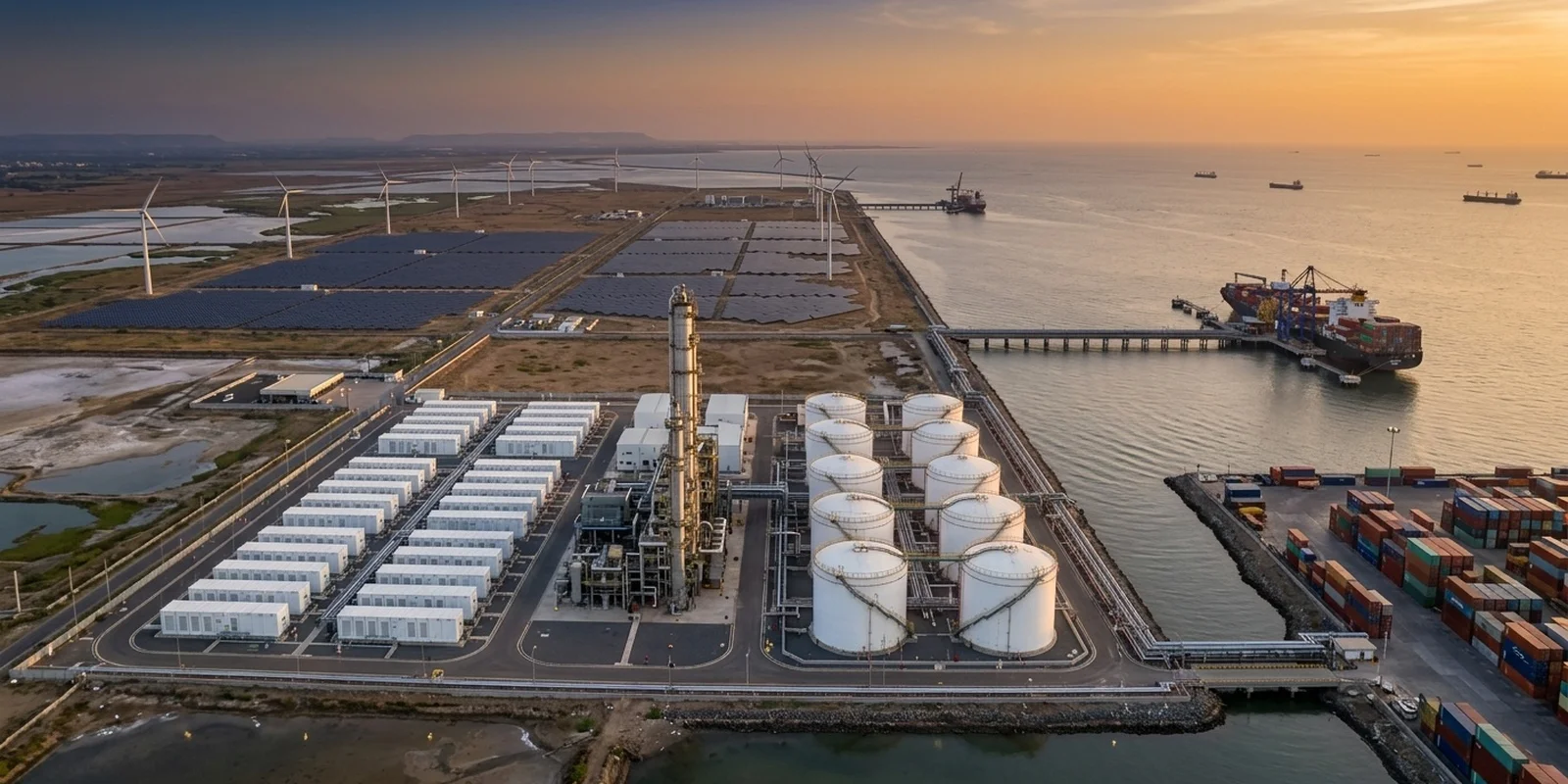
India’s First Port-Based e-Methanol Plant
- 150 tonnes a day of e-methanol, made from renewable power, water and biogenic CO2, for ships on the Asia–Europe route.
- ₹2,300 crore in two phases: 50 tonnes a day by January 2027 and another 100 tonnes a day by March 2027.
- Deendayal Port Authority and Assam Petro-Chemicals share the capital 76:24.
- The claimed cost is US$750 a tonne, against a global rate of about US$1,300. That is below the low end of IRENA’s 2021 cost range.
- At full output the plant meets roughly 11% of the port’s 500,000-tonne e-methanol goal for 2028–29 (our arithmetic).
Ships on one of the world’s busiest trade routes may soon be able to refuel with fuel made on India’s west coast from sunlight, wind and water. On 26 September 2026, the foundation stone was laid for India’s first port-based e-methanol plant at Kandla, inside the Deendayal Port Authority (DPA) in Gujarat. The plant is a ₹2,300 crore project. It is designed to make 150 tonnes a day of e-methanol, a low-carbon liquid fuel for ships, and to sell it to vessels on the Asia–Europe corridor.
We are writing this almost three weeks after the ceremony. In that time, the port and the ministry have published no construction update. The numbers below are therefore targets, not progress. They do show something useful, though. They tell us how big the plant is, how fast it is meant to be built and how much it claims the fuel will cost. Each of those can be checked against what green shipping fuel actually takes to make.
What The e-Methanol Plant At Kandla Will Build
The plant will be built in modules, in two phases. Phase I adds 50 tonnes a day of capacity for ₹1,200 crore and is due by January 2027. Phase II adds another 100 tonnes a day for ₹1,100 crore and is due by March 2027. At the full 150 tonnes a day, and assuming year-round running, that is about 54,750 tonnes of e-methanol a year.
The project is a joint venture between DPA and Assam Petro-Chemicals Ltd (APCL), a methanol producer based in Namrup, Assam. They share the capital 76:24. DPA’s share includes ₹567.32 crore of equity, 75 acres of port land, desalinated water, and renewable energy in the form of green hydrogen. The ministry expects more than 3,500 direct and indirect jobs. It also expects a wider local supply chain for transporting, storing and supplying “green molecules” to grow around the port.
How the project has grown since January
The plant looked different when it was first announced. Under the memorandum of understanding signed on 29 January 2026, APCL would build the production facility and DPA would supply pipelines, storage and fuel-handling infrastructure. The quoted investment was “more than ₹1,200 crore.” Eight months later, the budget has nearly doubled and the port is the majority owner. The carbon source has also been narrowed. In January it was “captured carbon dioxide.” It is now “biogenic” CO2, meaning carbon that comes from plants or organic waste rather than fossil fuels. That last change matters more than it looks, as the sections below explain.
What e-Methanol Is, And Why Ships Want It
Methanol is the simplest alcohol: one carbon atom, four hydrogen atoms and one oxygen atom. Today almost all of it is made from natural gas or coal. The chemical industry uses it in vast amounts, and producing it costs about US$100–250 a tonne, according to the International Renewable Energy Agency (IRENA). This fossil version is often called “grey” methanol.
E-methanol is the same molecule made a different way. Renewable electricity splits water into hydrogen and oxygen. The hydrogen is then combined with captured CO2 to make methanol. When that CO2 is biogenic, the carbon released when a ship burns the fuel was taken out of the atmosphere recently, not dug up from underground. Over its full life cycle, the fuel can therefore cut emissions sharply compared with oil-based marine fuel.
Ships like methanol for a practical reason. It is a liquid at normal temperature and pressure, so it can be stored and pumped much like conventional bunker fuel (the fuel ships burn). Hydrogen has to be compressed or chilled. Ammonia is toxic. Kandla is also well placed for it. The port has handled grey methanol as cargo for years, and it already has suitable tanks, pipelines and jetties. On 2 April 2026, the port carried out a trial transfer of methanol from shore to ship. DNV, the international ship-classification society, verified the trial on site. Before that, the port had been rated Level 6 on the International Association of Ports and Harbors’ readiness scale for methanol bunkering.
The $750-A-Tonne e-Methanol Claim, In Context
The headline figure is a production cost of about US$750 a tonne, against what the ministry calls a global rate of US$1,300. IRENA’s 2021 Innovation Outlook: Renewable Methanol gives a useful benchmark. It estimated that e-methanol made with biogenic CO2 cost US$800–1,600 a tonne to produce. With CO2 captured from the air instead, the range rose to US$1,200–2,400. On those figures, Kandla’s target is just under the cheapest end of the range, and the ministry’s “global rate” sits in the middle of it.
A target this low is plausible on paper. Renewable electricity is by far the biggest cost in making e-methanol, and Gujarat has some of the cheapest solar and wind power anywhere. Building the plant inside the port also removes the cost of moving the fuel to ships. The release, however, does not explain how the US$750 figure was calculated. It gives no assumed electricity price and no plant utilisation rate.
Why the per-tonne price flatters methanol
Shipowners buy energy, not tonnes. According to IRENA, a kilogram of methanol holds 19.9 megajoules of energy. Heavy marine fuel oil holds roughly twice that. So one tonne of fuel oil does the work of about two tonnes of methanol. On our arithmetic, US$750 a tonne works out to roughly US$1,500 for the same energy as a tonne of fuel oil, and the US$1,300 “global rate” to roughly US$2,600. Both are still well above what conventional marine fuel costs. Carbon rules are meant to close that gap. The EU’s FuelEU Maritime regulation already penalises high-carbon fuel on voyages to European ports. The International Maritime Organization’s (IMO) proposed Net-Zero Framework would add a global fuel standard and a price on emissions. Adoption is scheduled for a resumed session on 4 December 2026, subject to confirmation by the committee meeting just before it.
What 150 Tonnes A Day Will Need: Hydrogen, Carbon And Power
IRENA’s figures show what goes into every tonne of methanol: about 0.188 tonnes of hydrogen, 1.373 tonnes of CO2 and 10–11 megawatt-hours of electricity. Most of that electricity is used to split water. Applied to Kandla’s 150 tonnes a day, those ratios give the following daily inputs. The arithmetic is ours.
~28 t/day
green hydrogen, or about 10,300 tonnes a year
~206 t/day
biogenic CO2, or about 75,000 tonnes a year
~550–600 GWh
renewable electricity a year
Derived by Yellow Haze from IRENA (2021) input ratios, assuming full 150 TPD output year-round. These are not figures from the project.
Hydrogen is the largest of these needs. In July 2025, DPA commissioned a 1 MW green hydrogen plant at Kandla, rated at about 140 tonnes a year. That plant is the first module of a 10 MW project. The methanol plant would need more than 70 times its output. Even the full 10 MW project, if output scales in proportion, would supply only about a seventh of the requirement. Kandla’s electrolysers will therefore have to grow by an order of magnitude, or hydrogen will have to be brought in. The release does not say which.
The release also does not name the source of the CO2. The obvious candidates are biogas and fermentation plants, which give off a fairly pure stream of biogenic CO2 as a by-product. India’s GOBARdhan compressed biogas scheme is set to multiply that kind of capacity. Finally, there is the timeline. Phase I is due just four months after the foundation stone was laid. DPA did build its 1 MW electrolyser in four months, but a full plant chaining electrolysis, carbon supply and methanol synthesis is a far larger job. Phase I should be read as a target, not a promise.
Where The Kandla e-Methanol Plant Fits In India’s Green Shipping Plans
In September, we reported on India’s green shipping corridors, where Deendayal was named as one of three ports building a green fuel bunkering hub. At the time, no tonnage, investment or timeline figures came with it. This plant is that hub taking shape, and now it has numbers.
The plant is also only part of the port’s plan. In April 2026, DPA said it aims to secure about 500,000 tonnes a year of e-methanol by 2028–29 that meets the EU’s RFNBO standard (Renewable Fuels of Non-Biological Origin, the label that lets a fuel count towards European shipping targets). Kandla’s 54,750 tonnes would cover roughly 11% of that. The rest would have to come from further projects that have not yet been announced.
The project sits within a wider maritime push. The government plans to add 100 ships to India’s merchant fleet over the next five years. It is aiming for a place among the world’s top five ship-owning nations by 2047. Union Minister Sarbananda Sonowal described the goal plainly: Kandla “will become a green-fuel hub on the Singapore–Rotterdam route.” Like the green hydrogen buses and trucks now on trial routes, the plant is part of the National Green Hydrogen Mission’s effort to turn hydrogen into products that can be used and sold.
What It Means For India’s Energy Transition
Shipping is one of the hardest sectors to decarbonise. Ocean voyages need far more stored energy than batteries can carry, and ships stay in service for decades. The answer has to be new fuels. Aviation faces the same problem, which is why sustainable aviation fuel mandates are arriving at the same time. The e-methanol plant at Kandla is India’s first clear bid to make that fuel at a port, for export, rather than only buy it.
Whether the bid pays off depends on three things the release cannot settle yet. The first is whether the US$750 cost holds once the plant is running. The second is whether hydrogen and biogenic CO2 supply grow fast enough to feed it. The third is whether the IMO’s December vote gives shipowners a reason to pay a premium for low-carbon fuel. The plant’s 54,750 tonnes a year is small next to global shipping’s needs. Its location, cost target and route are the right ones, though. If Phase I produces fuel on schedule, Kandla becomes a working reference for every Indian port that wants to sell clean molecules to the world.
Frequently Asked Questions
What is e-methanol?
It is methanol made from green hydrogen, produced by splitting water with renewable electricity, combined with captured CO2. It is the same molecule as conventional methanol, which is made from natural gas or coal, but its life-cycle emissions are far lower. Because it is a liquid at normal temperature, ships can store and bunker it much like fuel oil.
When will the Kandla e-methanol plant start producing?
Phase I, which adds 50 tonnes a day, is targeted for January 2027. Phase II, which takes the plant to 150 tonnes a day, is targeted for March 2027. Construction began with the foundation stone on 26 September 2026. No progress update had been published as of mid-October 2026.
Who owns the Kandla e-methanol plant?
It is a joint venture between Deendayal Port Authority and Assam Petro-Chemicals Ltd, with capital split 76:24. DPA contributes ₹567.32 crore of equity, 75 acres of land, desalinated water and renewable energy in the form of green hydrogen.
Is $750 a tonne cheaper than conventional ship fuel?
No. A tonne of methanol carries roughly half the energy of a tonne of heavy fuel oil. So $750 a tonne is roughly $1,500 for the same energy, which is still well above conventional marine fuel. The figure is competitive against other e-methanol producers, not against fossil fuel. Carbon rules such as the EU’s FuelEU Maritime and the IMO’s proposed Net-Zero Framework are meant to close that gap.
Has Kandla already supplied methanol to a ship?
Yes, as a trial. On 2 April 2026, Kandla carried out a shore-to-ship methanol bunkering trial, verified on site by DNV. That fuel was conventional methanol. The new plant is meant to supply green e-methanol, and the port plans ship-to-ship bunkering next.
Source: Press Information Bureau — Ministry of Ports, Shipping and Waterways, 26 September 2026 (Release ID 2315327) | PIB — APL–DPA e-methanol MoU, 29 January 2026 (Release ID 2220467) | PIB — Kandla methanol bunkering, 9 April 2026 (Release ID 2250569) | PIB — DPA 1 MW green hydrogen plant, 31 July 2025 (Release ID 2150882) | IRENA — Innovation Outlook: Renewable Methanol, 2021 | IMO — MEPC 84 meeting summary, 2026.