

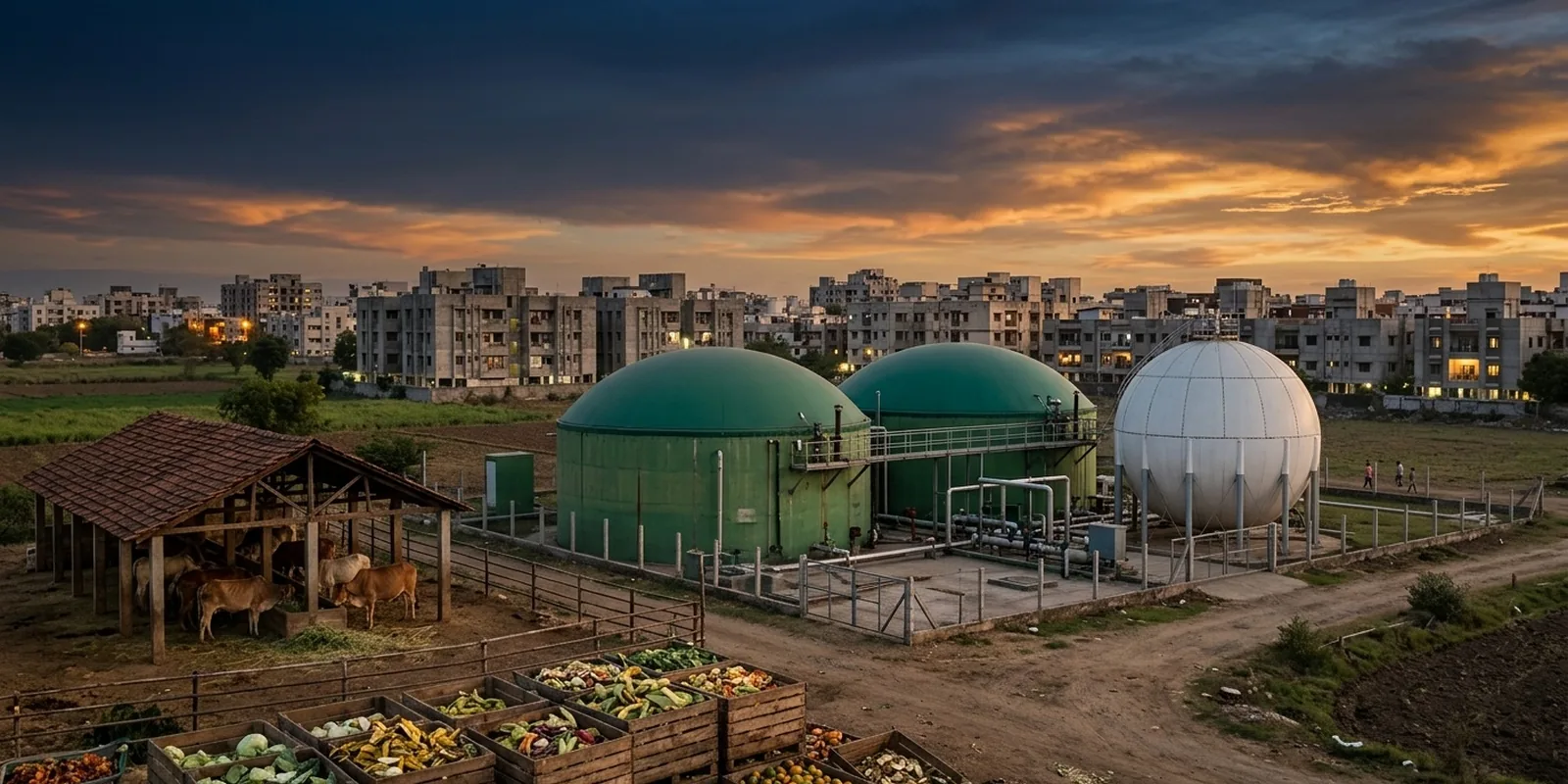
Power From Waste: Four Indian Sites Already Running On Biogas
💡 Biogas From Organic Waste In India: Key Highlights
- Hyderabad, Bowenpally market: about 10 tonnes of rotting produce a day becomes 400–500 units of electricity and 30 kg of biofuel, and the market’s power bill has roughly halved from about ₹3 lakh a month. Five more market-yard plants have been funded.
- Prayagraj: one plant takes four kinds of waste, 343 tonnes a day, and turns it into about 21 tonnes of bio-CNG and 28 tonnes of compost.
- Gwalior: a gaushala with 10,000+ cattle runs a ₹31 crore, 100-tonne-a-day compressed biogas plant built with Indian Oil Corporation. It makes 2 tonnes of gas and 10–15 tonnes of bio-manure a day.
- Gandhinagar: dung from 222 cows feeds 90 cubic metres of biogas a day. That covers all the cooking for 500+ people and replaces about 30 LPG cylinders a month.
- The backdrop: Indian cities generate nearly 1.62 lakh tonnes of municipal solid waste every day (PIB, January 2026).
At Hyderabad’s Bowenpally Vegetable Market, the streetlights now run on yesterday’s rotten tomatoes. That is the most vivid of four case studies in Power from Waste, a backgrounder the Press Information Bureau (PIB) published on 27 September 2026. It shows how biogas from organic waste in India has moved beyond pilot projects into everyday infrastructure. The other three sites are a cowshed in Gwalior, a campus kitchen in Gandhinagar and a city-scale fuel plant in Prayagraj. Each turns a different kind of waste into electricity, cooking gas or vehicle fuel, and each comes with numbers that can be checked.
We are covering the backgrounder about two and a half weeks after it appeared. It is worth the delay because of its timing. Swachh Bharat Mission-Urban 2.0 (SBM-U 2.0) was launched on 1 October 2021 as a five-year programme. Its “Lakshya: Zero Dumpsites” target for clearing legacy landfills also falls this month. This report is the government’s own evidence of what treating waste as a resource looks like on the ground. We re-checked its figures against earlier PIB releases on the same sites, and no newer numbers for any of the four have been published since 27 September.
How Biogas From Organic Waste Works, In Plain Terms
Leave cow dung, food scraps or crop stubble in a sealed tank with no oxygen and bacteria break it down. One of the things they give off is a methane-rich gas: biogas. The process is called anaerobic digestion. It produces two useful things at once, a fuel and a nitrogen-rich slurry that farmers can use instead of chemical fertiliser. PIB’s backgrounder calls biogas “among the most viable, economical and environmentally friendly cooking fuels available.”
What happens next depends on scale. Small plants burn the raw gas directly in a kitchen or a generator. Larger plants clean it up, removing carbon dioxide and impurities until it is chemically equivalent to natural gas. They then compress it into compressed biogas (CBG), which is sold as bio-CNG for vehicles or fed into city gas networks. The four sites in the report cover that whole range, from a single kitchen to a city’s bus depots. Together they are a practical tour of what waste-to-energy means in India today.
Four Sites, Four Models: Key Findings
Each site handles biogas from organic waste differently, by feedstock, scale and end use, so the figures are kept site by site below rather than averaged.
Hyderabad, Bowenpally: a market that powers itself
Bowenpally Vegetable Market collects roughly 10 tonnes of unsold vegetable and fruit waste every day. All of it used to go to landfill. Now an on-site plant chops and grinds the waste into slurry and feeds it to anaerobic digesters, storing the gas in balloons until it is needed. A 100% biogas generator turns the gas into 400–500 units (kWh) of electricity a day. That runs the market’s streetlights, stalls, cold-storage rooms, water pumps and admin building. Another 30 kg of biofuel a day goes to the market’s commercial kitchen, and the leftover slurry is sold to farmers as liquid manure.
The economics are the headline. PIB reports that the market’s electricity bill has roughly halved from an average of about ₹3 lakh a month. Hyderabad has already funded five more plants at other market yards: Gudimalkapur, Gaddiannaram, Erragadda, Alwal and Saroornagar, each sized to the waste its yard produces. The plant also employs women from the market community, who sort waste, run machinery and handle administration.
Gwalior, Laltipara: a gaushala that became a gas plant
Adarsh Gaushala in Laltipara is Gwalior’s largest cowshed. It is run by Gwalior Municipal Corporation and home to more than 10,000 cattle. Its 100-tonne-a-day CBG plant was inaugurated on 2 October 2024. The ₹31 crore, five-acre project was developed with Indian Oil Corporation. It turns 100 tonnes of cattle dung a day into about two tonnes of compressed biogas and 10–15 tonnes of dry bio-manure, which is sold cheaply to farmers in nearby districts. PIB describes it as India’s first modern, self-sufficient gaushala built around a CBG plant. It is also Madhya Pradesh’s first CBG plant designed to take vegetable and fruit waste from markets and homes alongside dung.
Prayagraj: one plant, four feedstocks
Prayagraj’s bio-CNG facility is the biggest of the four. It can process 343 tonnes of organic waste a day, from four sources: municipal wet waste, paddy straw, cattle dung and poultry litter. From that it produces about 21 tonnes of bio-CNG and 28 tonnes of compost daily. Using paddy straw gives farmers an alternative to burning stubble, the same problem India’s first paddy-straw biogas plant was built to tackle. The plant runs as a public-private partnership and takes bulk waste from hotels, restaurants and apartment complexes. Its daily wet-waste intake has grown from 7–8 tonnes at launch to around 125 tonnes. The gas is sold under the CBG–City Gas Distribution Synchronisation Scheme. It travels by the “cascade” route, in banks of high-pressure cylinders trucked to fuel stations, and currently supports city transport. Looking ahead, PIB expects the plant to supply piped gas to about 45,000 households and to cut roughly 57,000 tonnes of CO₂ a year.
Gandhinagar, Adalaj: a campus kitchen without LPG
At the Shrimati Manekba Vinay Vihar Educational Complex near Adalaj, the kitchen cooks for more than 500 people a day: about 250 hostel students who get two meals each, plus 15 staff families. The Vasumati Charitable Trust, which manages the campus, runs two biogas plants with a combined 90 cubic metres a day of capacity. They are fed with dung from the trust’s 222 cows, topped up with kitchen waste and crop residue. The gas covers the campus’s entire cooking need, which would otherwise take about 30 LPG cylinders a month. Gujarat’s Institutional Biogas Plant Scheme and the Gujarat Energy Development Agency (GEDA) provided the policy and financial support.
What The Numbers Show When You Compare Them
The backgrounder presents each site separately. Putting them side by side shows more. The figures below are our own arithmetic on PIB’s numbers, not figures PIB published:
- Bowenpally gets about 40–50 kWh of electricity from each tonne of market waste. Halving a ₹3 lakh monthly bill saves the market about ₹1.5 lakh a month, or roughly ₹18 lakh a year.
- Feedstock matters more than size. Prayagraj gets about 6 tonnes of bio-CNG from every 100 tonnes of mixed waste. Gwalior gets about 2 tonnes from 100 tonnes of dung (2–3 tonnes on PIB’s 2024 figure). Fresh dung is mostly water and has already been partly digested by the animal, so mixing in market, crop and food waste raises gas output per tonne. This explains why Gwalior was designed to take vegetable waste too.
- The by-product can outweigh the fuel. Prayagraj makes more compost (28 tonnes) than gas (21 tonnes) each day, and Gwalior makes five to seven times more manure than gas. Fertiliser is part of the business case, not a footnote.
- Supply grows once a plant proves reliable. Prayagraj’s wet-waste intake is up roughly sixteen-fold, from 7–8 tonnes to about 125 tonnes a day, as hotels and housing societies started sending their waste.
- Small plants count too. Gandhinagar’s 30 cylinders a month adds up to about 360 LPG cylinders a year that a single campus no longer buys.
The scale of the opportunity is large. A January 2026 PIB backgrounder on dumpsite remediation says Indian cities produce nearly 1,62,000 tonnes of municipal solid waste a day. It projects that greenhouse-gas emissions from the sector could reach 41.09 million tonnes of CO₂-equivalent by 2030 if waste is not processed scientifically. Much of that waste is organic, and organic waste rotting in landfills is a major source of methane. Every tonne diverted into a digester is a tonne that stops releasing methane into the open air.
How This Differs From India’s National CBG Scheme
Readers of this site will remember a much larger biogas story from August. The Union Cabinet approved GOBARdhan, India’s ₹23,731 crore compressed biogas scheme, to grow domestic CBG production nearly ten-fold by FY2035-36. That scheme is national policy and money: assured offtake, a fixed price, capital assistance and credit guarantees, run by the Ministry of Petroleum & Natural Gas. It builds on earlier offtake programmes such as SATAT.
The Power from Waste backgrounder is something else: proof from the ground that the model already works. It comes from PIB Research, with the Ministry of Housing and Urban Affairs as its reference, and it sits under Swachh Bharat Mission-Urban, the mission approved with a ₹1,41,600 crore outlay for its second phase. The funding behind each site is mixed: a state scheme in Gandhinagar, a public-private partnership in Prayagraj, a municipal corporation and Indian Oil in Gwalior, and city market funding in Hyderabad. When GOBARdhan launched, 1,908 CBG and bio-CNG plants were registered nationally and only 217 had been commissioned. Sites like these four are the operating track record that the ₹23,731 crore scheme is meant to multiply.
What It Means For India’s Energy Transition
Discussion of India’s energy transition tends to focus on gigawatts of solar and wind. These four sites point to a quieter shift that is just as important: energy produced where the waste is. A market that makes its own electricity, a campus that stops buying LPG and a cowshed that sells fuel all cut the cost of energy, cut the methane from waste, and replace fossil fuel with a renewable one. They also keep the money in the local economy, through jobs for market workers, manure for nearby farmers and lower bills for municipal bodies.
Some limits are worth stating. All four sites rely on a steady, segregated supply of waste. That is why market yards, gaushalas and institutional kitchens make natural first sites, and why Prayagraj’s supply grew only after bulk generators were brought in. Mixed household waste is much harder to work with. The projections for Prayagraj (45,000 households, 57,000 tonnes of CO₂ a year) are targets, not results achieved yet. Still, the direction is clear. Biogas from organic waste in India is no longer a demonstration technology. Small and medium plants already deliver measurable savings, and GOBARdhan is now in place to scale them up. For campuses, hotels and housing societies looking at the smallest version of this model, our overview of turning food waste into biogas is a good place to start.
📄 Download: “Power from Waste — Inside Swachh Bharat Mission Waste-to-Energy Story”
The full 6-page PIB backgrounder (27 September 2026) has all four case studies, with photographs of each plant. It is a useful primary source for city planners, developers and anyone following India’s circular economy.
Download The Full Backgrounder (PDF)Frequently Asked Questions
How is biogas made from organic waste?
Organic waste such as cow dung, food scraps, market produce or crop residue is sealed in an oxygen-free tank called a digester, where bacteria break it down and release a methane-rich gas. The gas can be burned directly for cooking or electricity, or purified and compressed into bio-CNG. The leftover slurry is a nitrogen-rich organic fertiliser.
How much electricity does the Bowenpally market biogas plant produce?
According to PIB, the plant turns about 10 tonnes of vegetable and fruit waste a day into 400–500 units (kWh) of electricity and about 30 kg of biofuel. The power runs the market’s streetlights, stalls, cold storage, water pumps and admin building, and the market’s electricity bill has roughly halved from about ₹3 lakh a month.
What is the difference between biogas, bio-CNG and CBG?
Biogas is the raw gas from a digester: mostly methane, mixed with carbon dioxide and impurities. When it is cleaned to natural-gas quality and compressed, it becomes compressed biogas (CBG). When that gas is used as vehicle fuel, it is usually called bio-CNG. In practice, CBG and bio-CNG describe the same upgraded product.
Are these plants part of the GOBARdhan scheme?
Not as presented. PIB’s backgrounder places all four under Swachh Bharat Mission-Urban 2.0, with funding from a mix of state schemes, public-private partnerships, municipal bodies and Indian Oil. GOBARdhan is the separate ₹23,731 crore national CBG scheme approved in August 2026 to scale this kind of production nearly ten-fold by FY2035-36.
Which kinds of waste work best for biogas?
All the usual organic streams work: dung, food and market waste, crop residue and poultry litter. They produce different amounts of gas. On PIB’s figures, Prayagraj’s mixed feedstock yields about 6 tonnes of bio-CNG per 100 tonnes, while Gwalior’s dung-led plant yields about 2–3 tonnes. Mixing several feedstocks and keeping a steady supply of well-segregated waste matter most.
Source: PIB Backgrounder: Power from Waste — Inside Swachh Bharat Mission Waste-to-Energy Story — PIB Research, Press Information Bureau (reference: Ministry of Housing and Urban Affairs), 27 September 2026 (Release ID 2315501).