India Green Shipping Corridors: Ports Fast-Track Shore Power And Green Fuel Bunkering
India green shipping corridors move from plan to port: Kamarajar's coal terminals now run shore power, while three ports build green fuel bunkering hubs.

India’s Green Shipping Corridors Take Shape
- Kamarajar Port’s coal terminals now have working shore power — berthed ships draw electricity from land, not their own engines.
- Deendayal, Paradip and V.O. Chidambaranar reported progress on Green Fuel Bunkering Hubs.
- All three bunkering-hub ports were recognised as Green Hydrogen Hubs in October 2025.
- Shipping emitted 1,076 million tonnes of CO2-equivalent in 2018 — 2.89% of global emissions.
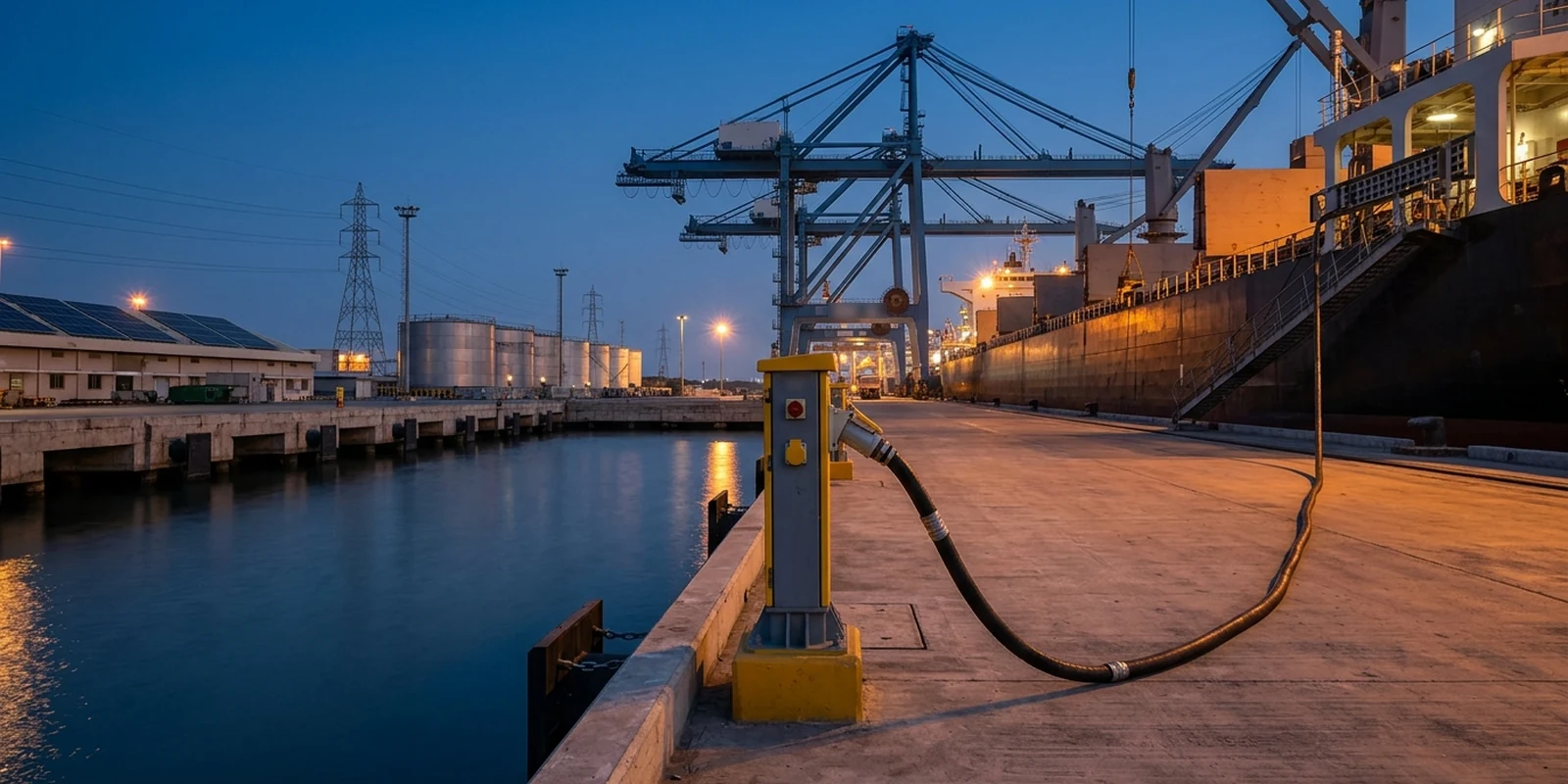
India’s green shipping corridors have spent three years as a plan on paper. On 3 September 2026 the Union Minister for Ports, Shipping and Waterways, Sarbananda Sonowal, sat down at The Energy and Resources Institute’s campus in Gurugram to find out how much of that plan had reached the quayside — and one port had a working answer. Kamarajar Port Limited reported that its coal terminals are now equipped with shore power, letting vessels at berth plug into land-based electricity instead of idling their diesel engines.
Everything else is still being built: this was a status review, not a scheme launch.
What The Ministry Reviewed On India’s Green Shipping Corridors
The centrepiece was a review of the proposed green shipping corridors and of port readiness for alternative fuels. A corridor is less infrastructure than negotiated agreement — a specific route where governments, ports, shipowners and fuel suppliers line everything up so a low-emission voyage becomes possible, since a clean ship is useless if it cannot refuel at the far end.
Who briefed the minister
The National Centre of Excellence for Green Ports and Shipping, the research body the ministry leans on for maritime decarbonisation, set out its mandate and project pipeline. The Rocky Mountain Institute presented its work developing low- and zero-emission shipping corridors. “Our ports must become ready for the fuels of tomorrow,” Sonowal said.
Shore Power At Kamarajar Port: Ships That Switch Off Their Engines
A cargo ship does not stop burning fuel when it stops moving. At berth it still needs power for lighting, pumps, ventilation and cargo handling, and it usually runs auxiliary diesel generators to get it — sometimes for days. Shore power, known in the industry as cold ironing, replaces those generators with a cable: the ship connects to a landside supply and shuts its engines down.
Kamarajar Port, north of Chennai, started at a pointed place: coal terminals handle the dirtiest cargo a port sees. The gain is not only a climate number, either — the sulphur dioxide, nitrogen oxides and particulates an idling ship emits are released a few hundred metres from dock workers and, at many Indian ports, from homes.
Shore power moves that combustion onto the grid, so it is only ever as clean as the electricity behind it — and India has now crossed 300 GW of non-fossil power capacity. Some ports beat that mix: at the launch of the ‘Harit Sagar’ Green Port Guidelines in May 2023, officials noted four major ports already generated more renewable energy than they consumed.
Green Fuel Bunkering Hubs At Deendayal, Paradip And V.O. Chidambaranar
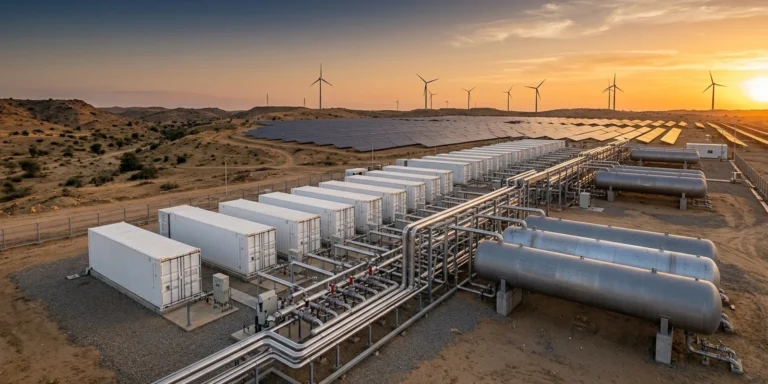
Bunkering means refuelling a ship, so a green fuel bunkering hub is a port equipped to store, handle and supply the fuels the sector is betting on next — green hydrogen, green ammonia and green methanol, made with renewable electricity rather than fossil feedstock. Deendayal in Gujarat, Paradip in Odisha and V.O. Chidambaranar in Tamil Nadu each reported progress on building one.
Those three names are not a new shortlist. In October 2025 the Ministry of New and Renewable Energy recognised the same three port areas as Green Hydrogen Hubs under the National Green Hydrogen Mission, clustering production, storage and consumption in one place so early projects stay viable. Deendayal shows this has moved past paperwork: in July 2025 it commissioned a 1 MW green hydrogen plant at Kandla, producing roughly 140 tonnes a year as the first module of a 10 MW project, and has since put India’s first indigenously built all-electric harbour tug into service.
The limits matter too: no tonnage or investment figures were attached to any of the three hubs, and what was reported was progress, not commissioning. Designating hub ports answers a chicken-and-egg problem — nobody orders ammonia-burning ships with nowhere to fill them, and nobody builds ammonia storage for ships that do not exist. It is a different bet from India’s push on hydrogen in road transport: same hydrogen mission, nothing like the same volumes.
Why Shipping Is Harder To Decarbonise Than Road Transport
Three things make shipping the case that explains why “hard to abate” is a category at all. Energy density: an ocean crossing needs more stored energy than a battery pack can carry, and there is no fast-charger halfway to Rotterdam. Asset life: ships work 25 to 30 years, so a vessel ordered today is still sailing in the 2050s. Jurisdiction: a voyage between two countries belongs to neither regulator, so the rules are written at the International Maritime Organization.
The gap is documented. The Fourth IMO Greenhouse Gas Study put shipping’s emissions at 1,076 million tonnes of CO2-equivalent in 2018, or 2.89% of global human-caused emissions — a rising share. The 2023 IMO Strategy answers with net zero “by or around 2050” and checkpoints of at least 20% by 2030 and 70% by 2040 against 2008 levels. One target lands on ports directly: zero or near-zero emission fuels supplying at least 5%, striving for 10%, of shipping’s energy by 2030.
The rulebook is not settled either: the IMO Net-Zero Framework, a global fuel standard plus emissions pricing, was approved in April 2025, but the session convened to adopt it adjourned in October 2025 without a decision. Aviation is running a near-identical sequence, which is why India’s airlines are also preparing for a sustainable aviation fuel mandate still being argued over.
Batteries do solve plenty inside the port fence, though. Harit Sagar lists electrification of port equipment alongside shore power, and once electric harbour craft, yard machinery and shore-power berths sit behind one connection, the constraint becomes load management — the problem YoCharge’s charging management platform solves on land. The ships themselves still need molecules.
What It Means For India’s Energy Transition
India’s clean-energy story is told almost entirely through rooftop solar, grid capacity and electric vehicles. Shipping is the quiet third front, and ports sit unusually within it — large energy consumers that are also becoming energy producers. The commercial logic runs under the environmental one: if the IMO framework is adopted, fuel availability becomes a routing decision, because ships will call where they can refuel compliantly. India sits astride the east-west routes between Europe and East Asia, and the ministry wants Indian ports competing for that traffic.
Where India’s green shipping corridors actually stand today is modest: working shore power at one port’s coal terminals, hub recognition and early hydrogen production at three others, corridor design still at the partnership stage. Against a commitment to net zero by 2070, that is a small start — but one made in the right order, at the ports the fuels must flow through.
Frequently Asked Questions
What is a green shipping corridor?
A specific route where governments, ports, shipowners and fuel suppliers coordinate so low-emission voyages become possible: green fuel at both ends, ships able to use it, rules that recognise it. Corridors are agreements, not structures.
What is shore power, and which Indian port has it?
Shore power, or cold ironing, lets a ship at berth draw electricity from land instead of running its own diesel generators. Kamarajar Port Limited reported in September 2026 that its coal terminals have it.
Which Indian ports are building green fuel bunkering hubs?
Deendayal (Gujarat), Paradip (Odisha) and V.O. Chidambaranar (Tamil Nadu) — all three recognised as Green Hydrogen Hubs under the National Green Hydrogen Mission in October 2025.
Why is shipping harder to decarbonise than cars and trucks?
Ocean voyages need far more stored energy than batteries can carry, with no refuelling point mid-route. Ships last 25 to 30 years, locking in today’s fuel choice for decades. And an international voyage falls outside any one regulator, so rules must be agreed globally at the IMO.
Source: Press Information Bureau — Ministry of Ports, Shipping and Waterways, 3 September 2026 (Release ID 2306501) | 2023 IMO Strategy on Reduction of GHG Emissions from Ships — International Maritime Organization.