

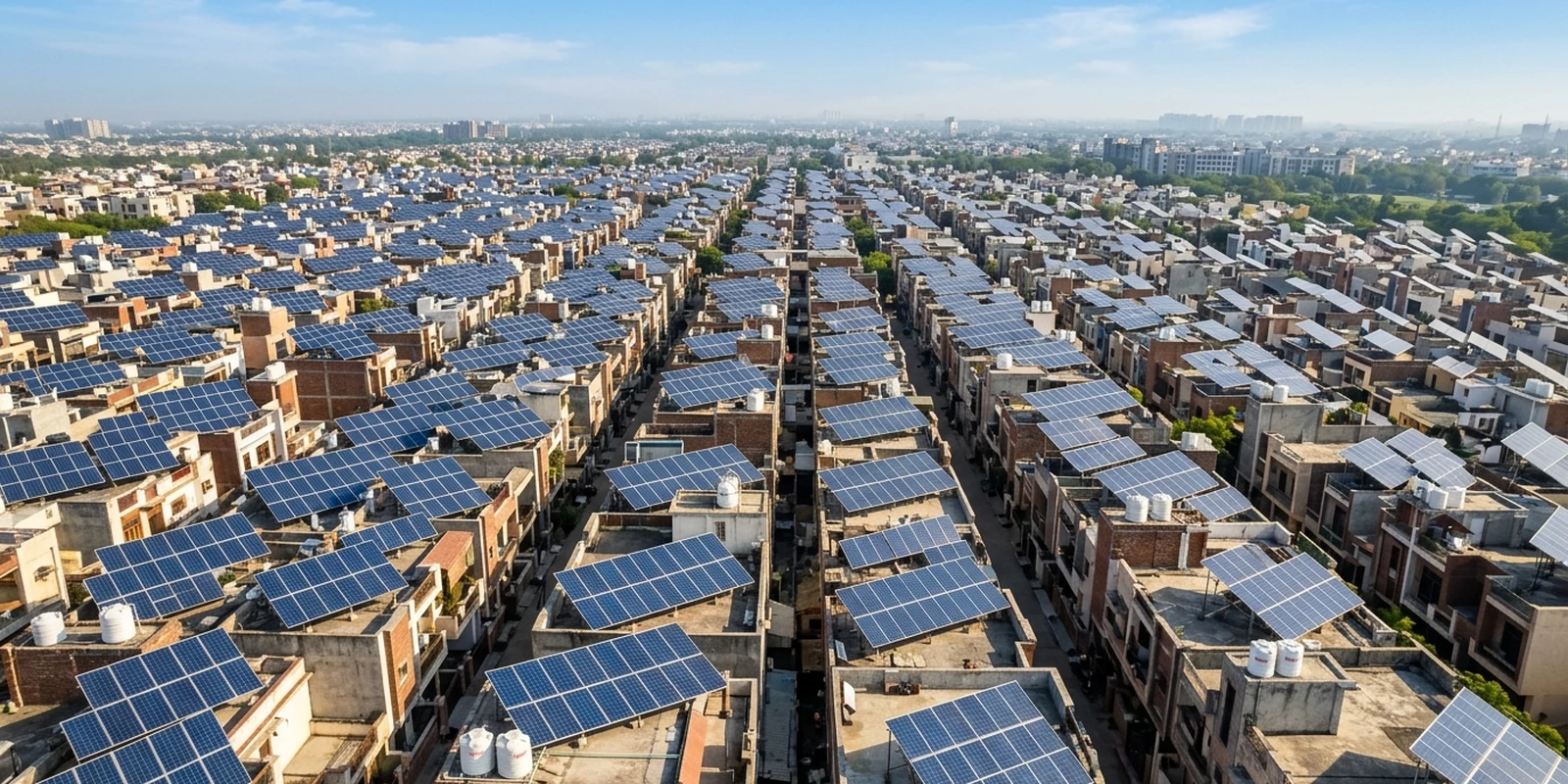
PM Surya Ghar Hits 50 Lakh Households — July Sets A New Solar Record
- 50.06 lakh households now benefit from PM Surya Ghar as of 4 Aug 2026 — up from 48.02 lakh just two weeks earlier
- Installation pace has accelerated 3.2x in nine months: 5,038/day (Oct 2025) to 16,328/day (Jul 2026)
- July 2026 was the scheme’s best month ever — 5.06 lakh households added in a single month
- ₹28,024 crore released via Direct Benefit Transfer; ~19 lakh households now report zero electricity bills
- 34,219 registered vendors and 2.32 lakh+ people trained across the rooftop solar value chain
- 1.06 lakh government buildings solarised so far — 25,255 central plus 81,329 state
India’s rooftop solar programme has cleared its next big number. PM Surya Ghar: Muft Bijli Yojana crossed 50.06 lakh beneficiary households as of 4 August 2026, per a fresh Ministry of New & Renewable Energy release — and the number underneath it is more striking. Installation pace has accelerated 3.2x in nine months, from 5,038 a day in October 2025 to roughly 16,328 a day in July 2026, which alone added a record 5.06 lakh households. The scheme is now adding a lakh new households roughly every six days.
This is an update to our earlier coverage of PM Surya Ghar, published when the scheme had just crossed 48.02 lakh households on 22 July 2026 — a figure already dated less than two weeks later, which is the real story: the count is a snapshot, the acceleration is the trend. Below: the subsidy math, the vendor ecosystem behind it, and a government-building solarisation push easy to miss in the headline number.
The acceleration behind PM Surya Ghar’s 50 lakh households milestone
India installed rooftop solar for just 7.94 lakh households in the ten years before PM Surya Ghar launched in February 2024. In a little over two years, the scheme has added more than six times that, and the curve is bending upward, not flattening. Daily installations climbed from 5,038 (October 2025) to 16,328 (July 2026) — a 3.2x jump in nine months — with July’s 5.06 lakh households the highest monthly figure on record. That’s a step-change in execution: procurement, vendor onboarding, and subsidy disbursal all had to scale together to make it possible.
Where the ₹28,024 crore in subsidy is going
The government has released ₹28,024 crore in subsidy directly to beneficiaries via Direct Benefit Transfer — money that lands in a household’s account within 15 days, via PFMS, rather than routing through a vendor. Nearly 19 lakh households now report zero electricity bills, and more than 12 lakh households collectively earned ₹421 crore selling surplus power back to the grid in FY2024-25, about ₹3,500 per household per year. For households that can’t front the upfront cost even with subsidy, the Utility Led Aggregation model lets a third party own and operate the system on their behalf — 1.6 lakh installations done for PMAY/BPL/SC-ST households across four states, sanctioned for 12 more. Those who want to own their system can borrow at 5.75% (repo + 50 bps): 21.87 lakh applicants sanctioned, 17.5 lakh loans already completed, processed paperlessly through Jan Samarth and the national portal.
The vendor ecosystem powering the scale-up
Scaling installations this fast needed an industry to install them. PM Surya Ghar has built one: 34,219 registered vendors (29,469 active) and more than 2.32 lakh people trained under its capacity-building programmes — a genuine employment story spread nationwide, not concentrated among a few large EPC contractors. Keeping that base accountable: a City Accelerator Programme (46 cities), ~23,000 third-party quality inspections, a star-rating framework, and a new Payment Security Mechanism for RESCO bidders.
1.06 lakh government buildings gone solar
Rooftop solar under PM Surya Ghar isn’t only a household story. Central Ministries have solarised 25,255 of ~41,542 feasible government buildings (872 of 1,418 MW potential); states have solarised 81,329 of ~3.2 lakh feasible buildings (1,450 of 4,400 MW potential). Together, 1.06 lakh government buildings — schools, panchayat offices, administrative blocks — now generate their own power, a scale easy to overlook next to the household headlines.
What it means
The 50-lakh-household figure will read, in a year, like the 48-lakh figure reads today: already dated. What won’t date as fast is the curve behind it — installations per day nearly tripling in nine months, a vendor base past 34,000 registrations, and a subsidy pipeline fast enough to keep up with 16,000+ installations a day. That’s the real signal: rooftop solar adoption is still steepening, not plateauing, two years in.
A quieter shift is worth watching too. Over 12 lakh households are already paid for surplus power exported to the grid — distributed generation resembling the building blocks of a virtual power plant: small, grid-connected systems a utility could eventually coordinate as one flexible resource. What a household does with that surplus — sell it via net metering, or trade it with a neighbour — is a decision millions of beneficiaries are only now facing; YoGrid’s explainer on net metering versus peer-to-peer energy trading is a useful primer.
Frequently Asked Questions
What is PM Surya Ghar: Muft Bijli Yojana?
A Government of India scheme (launched Feb 2024) subsidising rooftop solar for households to cut or eliminate electricity bills.
How many households does PM Surya Ghar cover as of August 2026?
50.06 lakh, as of 4 August 2026 — up from 48.02 lakh on 22 July 2026.
How is the subsidy paid out?
Directly to beneficiaries via Direct Benefit Transfer through PFMS, within 15 days of installation. ₹28,024 crore disbursed so far.
Can a household earn from surplus solar power?
Yes — 12+ lakh households collectively earned ₹421 crore selling surplus power to the grid in FY2024-25, about ₹3,500/household/year.
Source: Press Information Bureau — Ministry of New & Renewable Energy, 4 Aug 2026 (PRID 2294208).