

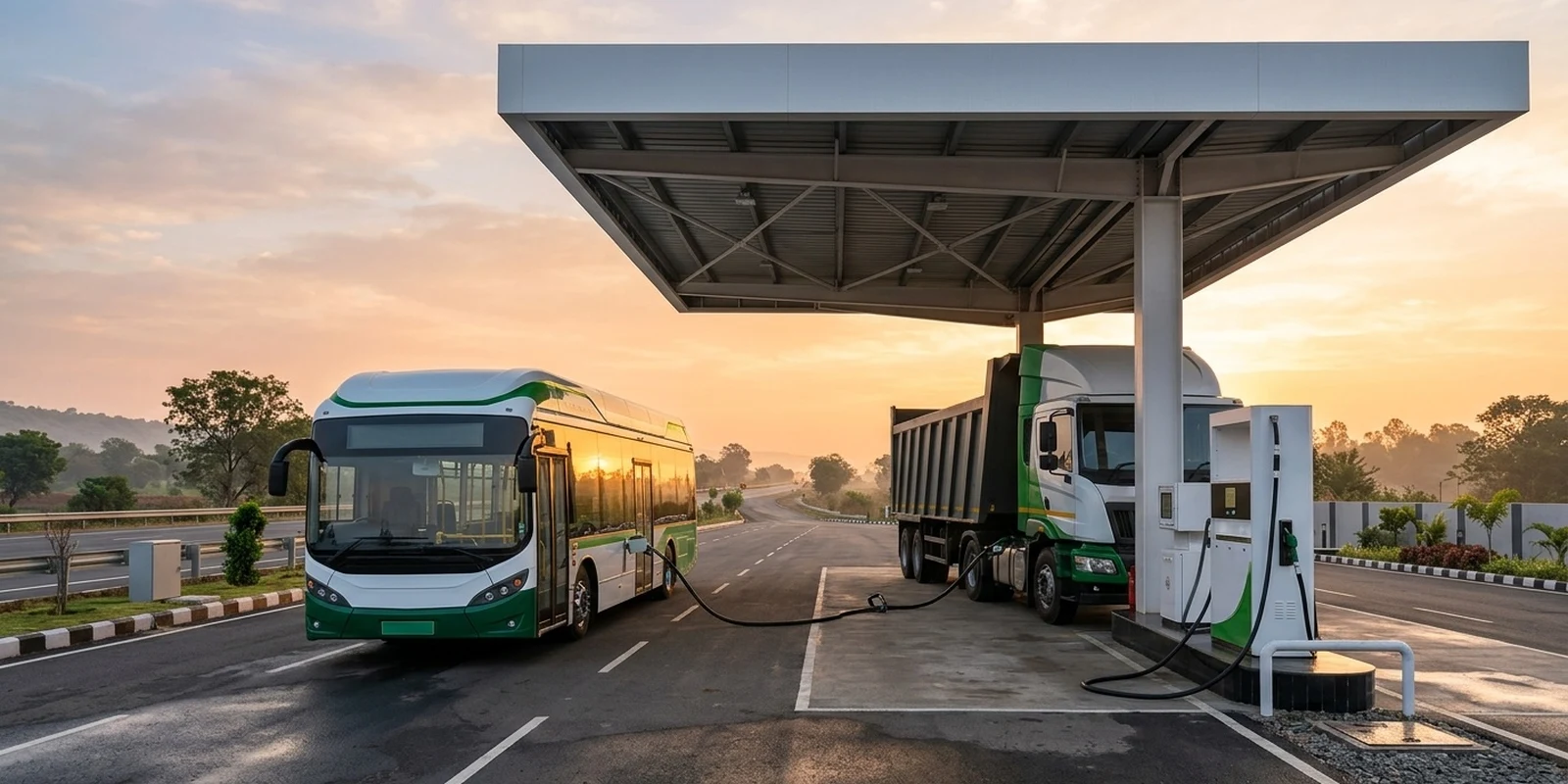
70 Hydrogen Buses And Trucks Hit Indian Roads
💡 Green Hydrogen Vehicles Pilot India: Key Highlights
- 70 hydrogen-powered vehicles funded — 27 buses and 43 trucks — across 12 pilot projects under the National Green Hydrogen Mission
- 21 routes, 16 refuelling stations, spanning Gujarat, Kerala, Odisha, Maharashtra, Madhya Pradesh and Himachal Pradesh
- ₹410.77 crore allocated; ₹41.58 crore released so far, with Viability Gap Funding covering up to 90% of each project’s cost
- Big-name consortia: NTPC, Tata Motors, Reliance, HPCL, BPCL, IOCL, Ashok Leyland and Volvo
- Two technologies in play: Fuel Cell Electric Vehicles (FCEVs) and Hydrogen Internal Combustion Engine (H₂-ICE) vehicles
- Trucks (43) outnumber buses (27) — hydrogen’s fast refuelling suits long-haul freight best
India’s green hydrogen vehicles pilot has moved from paperwork to pavement. A written Lok Sabha reply from the Ministry of New and Renewable Energy confirms 12 pilot projects under the National Green Hydrogen Mission (NGHM) have funded 70 hydrogen-powered buses and trucks running on 21 routes, backed by 16 refuelling stations being built alongside them. Roughly ₹410.77 crore is committed, with the government covering up to 90% of each project’s cost. This isn’t a lab demo — it’s real vehicles on real highways, generating the operating data that will decide whether hydrogen becomes a mainstream option for India’s road transport.
India’s Green Hydrogen Vehicles Pilot, By The Numbers
70
Hydrogen vehicles funded
21
Routes across India
16
Refuelling stations
₹410.77 Cr
Total financial assistance
The fleet splits into 27 buses and 43 trucks, mixing FCEVs and H₂-ICE vehicles, across 12 projects awarded in two phases. Of the ₹410.77 crore allocated, ₹41.58 crore has been released — the rest follows project milestones, since Viability Gap Funding covers up to 90% of each project’s sanctioned cost. The government is deliberately absorbing most of the financial risk on a technology still commercially unproven at scale in India, so consortia can focus on getting vehicles running rather than first-of-its-kind economics.
FCEV vs H₂-ICE: Two Ways To Run On Hydrogen
The Ministry’s reply uses both acronyms without explaining them — worth doing here, since they represent genuinely different bets on how hydrogen vehicles should work.
Fuel Cell Electric Vehicles (FCEVs)
A fuel cell combines hydrogen with oxygen from the air to generate electricity, which then drives an electric motor — water vapour is the only tailpipe output. The driving experience is close to a battery EV: silent, smooth, instant torque. The trade-off is cost — fuel cell stacks use costly catalysts and add engineering complexity.
Hydrogen Internal Combustion Engine (H₂-ICE) Vehicles
H₂-ICE vehicles burn hydrogen directly in a modified combustion engine, much like today’s engines burn diesel. It’s noisier and less efficient than a fuel cell, but far cheaper and faster to retrofit — makers can adapt an existing engine line rather than build a new fuel-cell supply chain. That practicality likely explains why H₂-ICE features so heavily among this pilot’s trucks: it’s the pragmatic bridge while fuel-cell costs keep falling.
Who’s Building It: Consortia And Routes
Phase I sanctioned ₹207.91 crore across five consortia for 10 buses and 27 trucks; Phase II added ₹202.86 crore across seven more consortia for 17 buses and 16 trucks — 12 in all, each pairing a vehicle-maker with a fuel or engine-technology partner and usually an oil marketing company for refuelling stations. Rather than reproduce the full annexure, four Phase I examples show how concrete the routes already are:
- NTPC + Ashok Leyland — buses on the Delhi–Agra and Bhubaneswar–Puri corridors
- Tata Motors + Indian Oil — the widest footprint: Ahmedabad–Vadodara–Surat, the Delhi–NCR belt, Pune–Mumbai, and Jamshedpur–Kalinga Nagar
- Reliance Industries + Ashok Leyland — Jamnagar–Ahmedabad in Gujarat
- HPCL + Volvo — Visakhapatnam–Bayyavaram in Andhra Pradesh
Phase II extends the map further — NHPC in Himachal Pradesh, VECV and BPCL in Madhya Pradesh, WAAREE and EKA Mobility on more Gujarat corridors, and additional Kerala routes — taking the pilot to at least eight states in all.
Why Trucks Outnumber Buses 43 To 27
The 43-to-27 truck-to-bus split isn’t accidental. Long-haul freight is exactly where hydrogen’s advantage over battery power shows up clearest: refuelling time. A hydrogen tank fills in minutes, much like diesel; a heavy-duty battery-electric truck can need an hour or more on a high-power charger for meaningful range. For an operator paid by the load delivered, an hour lost to charging is an hour of lost revenue — and batteries large enough to skip that stop add weight that eats directly into payload.
Buses run fixed, predictable routes and can usually recharge overnight at a depot, so the refuelling-speed argument matters less for them. It’s freight, not passenger transport, where minutes saved at the pump translate directly into money — which is why this pilot, like hydrogen-trucking programmes elsewhere, leans harder into trucks.
What It Means
None of this proves hydrogen mobility will scale nationally — that’s the point of a pilot. The Ministry confirms a structured monitoring mechanism is already in place: executing agencies must report on vehicle efficiency, fuel consumption, safety and utilisation, feeding a techno-economic viability assessment before any wider rollout. India is testing hydrogen road transport on a small, monitored scale before committing serious capital — the same cautious posture it’s applying to hydrogen rail, where the hydrogen fuel-cell train on the Jind–Sonipat route is generating a comparable dataset for a different mode.
Whichever way the data points, it answers a question that matters for India’s freight and transit decarbonisation: whether the road-transport backbone ends up running on batteries, hydrogen, or a mix of both. This ₹410.77 crore green hydrogen vehicles pilot is where that case gets made — or quietly shelved — feeding into a wider National Green Hydrogen Mission goal of making India a global hub for green hydrogen production, use and export, with vehicles as just one of several demand streams the mission is trying to prove out. The Ministry’s mission page has the full policy architecture.
Frequently Asked Questions
What is the National Green Hydrogen Mission?
India’s programme to build a domestic green hydrogen economy, aiming to make the country a global hub for producing, using and exporting green hydrogen. This vehicle pilot is one of several demand-side initiatives under the mission.
What’s the difference between an FCEV and an H₂-ICE vehicle?
An FCEV converts hydrogen into electricity through a fuel cell to power an electric motor — silent and efficient, like a battery EV. An H₂-ICE vehicle burns hydrogen directly in a modified combustion engine, like today’s diesel engines. H₂-ICE is cheaper and faster to retrofit; FCEVs are more efficient but costlier.
How many hydrogen vehicles has India deployed under this pilot?
12 pilot projects under the National Green Hydrogen Mission have funded 70 hydrogen-powered vehicles — 27 buses and 43 trucks — across 21 routes, supported by 16 refuelling stations.
Why does the pilot fund more hydrogen trucks than buses?
Hydrogen’s biggest edge over battery power is refuelling speed. That matters far more for long-haul trucks, where every hour charging is lost revenue and every kilogram of battery is less freight, than for buses on fixed routes that can recharge overnight at a depot.
When will India decide whether to scale hydrogen vehicles nationally?
No date has been set. A structured monitoring mechanism requires agencies to report on efficiency, fuel consumption, safety and utilisation, and those findings will feed a techno-economic viability assessment shaping future policy and deployment.
Source: PIB Delhi — Ministry of New and Renewable Energy, 29 Jul 2026 (PRID 2291541).