India Geothermal Power Potential: What The 10.6 GW Figure Means After Ladakh’s First Wells
India geothermal power potential is put at 10.6 GW — a theoretical GSI estimate, not a target. What Ladakh's first two geothermal wells actually change.

India’s Geothermal Power Potential
💡 India Geothermal Power Potential: Key Highlights
- Two wells, 1,000 metres deep each, commissioned at Puga Valley, Ladakh, in July 2026 by the ONGC Energy Centre — India’s first, drilled above 14,000 feet.
- Their job is reservoir evaluation, clearing the way for India’s first 1-megawatt demonstration geothermal power project.
- The resource base is nearly 10.6 GW — a theoretical estimate from the Geological Survey of India’s 2022 Geothermal Atlas, not a target.
- GSI has mapped 381 hot springs across 10 provinces; just 42 sites are rated promising.
- Global installed capacity hit 15.67 GW by end-2025. India’s is still zero.
For decades, India geothermal power potential has been a footnote in the country’s clean energy story — a number in a geological survey rather than a plant on the grid. That changed in July 2026, when the ONGC Energy Centre commissioned India’s first two geothermal wells in Puga Valley, Ladakh. On 4 September 2026 the Press Information Bureau published a backgrounder pulling the picture together: a policy notified a year earlier, five pilots in the field, and a resource base of nearly 10.6 GW the country has barely touched.
The wells are modest — two boreholes, a kilometre deep each. What makes them a milestone is simpler than any number: India has finally drilled for electricity from the Earth’s own heat, not just mapped where that heat might be.
India’s First Geothermal Wells: What Was Commissioned In Ladakh
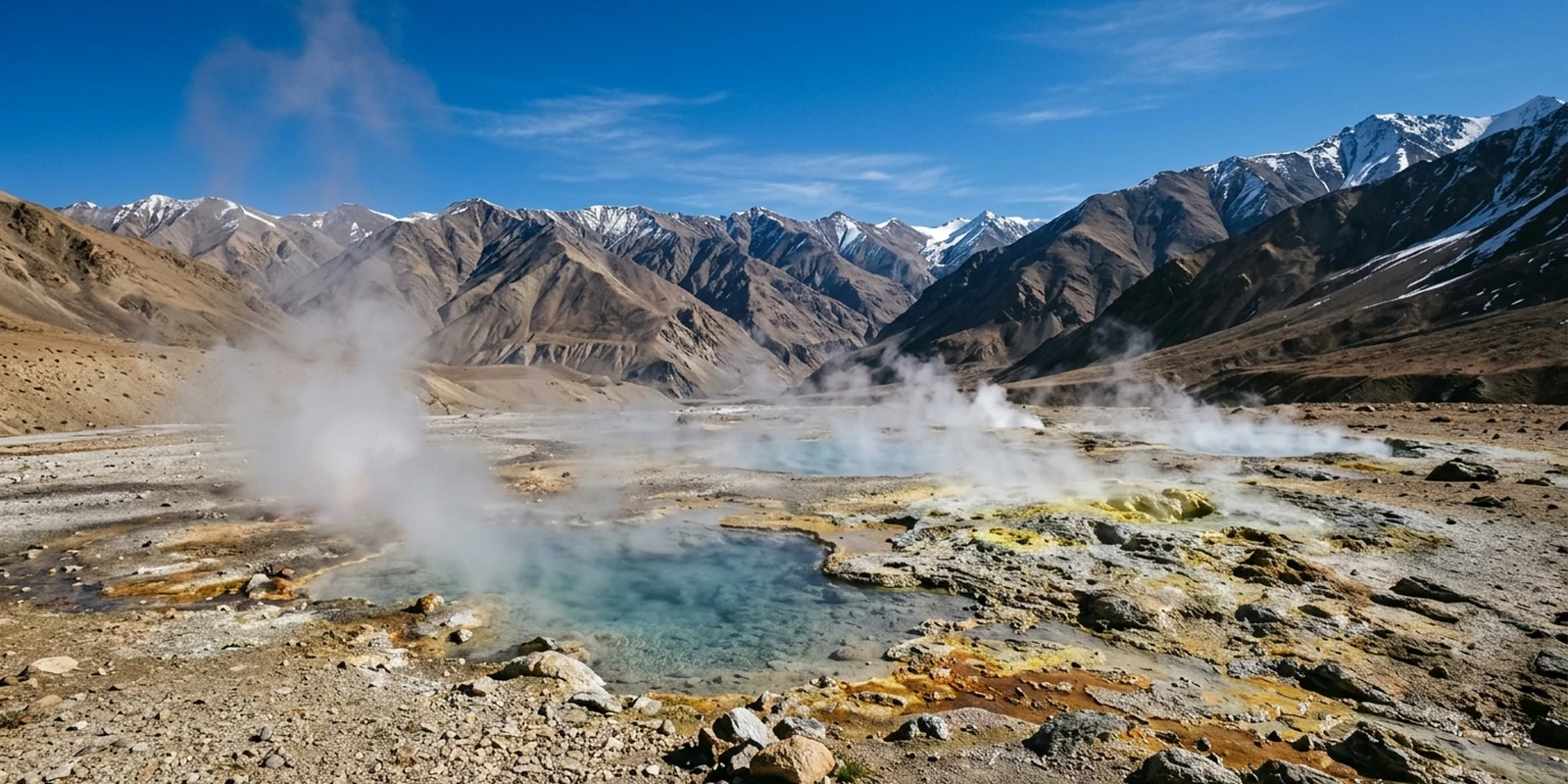
Puga Valley sits in eastern Ladakh above 14,000 feet — roughly 4,300 metres, in a cold desert where the ground steams. Its hot springs and shallow heat reserves have long made it India’s most-studied geothermal site, and the backgrounder calls it among the most promising.
In July 2026 the ONGC Energy Centre commissioned two wells there, each drilled to 1,000 metres. Their job is not generation but reservoir evaluation — how hot the resource runs, how much fluid it yields, whether output can be sustained. That data is the gate to India’s first 1-megawatt demonstration geothermal power project at the same site.
The gap between a mapped resource and a drilled one is the whole story of Indian geothermal. Hot springs have been catalogued for decades; wells that can be tested, logged and re-entered are new.
Key Findings From The Government’s Geothermal Backgrounder
The National Policy on Geothermal Energy was notified in September 2025, with the Ministry of New and Renewable Energy (MNRE) as nodal ministry. It backs exploration and drilling, supports Ground Source Heat Pumps for building heating and cooling, lets unproductive oil and gas wells be repurposed, and funds a national data repository, pilots and Centres of Excellence.
Around it sit 381 catalogued hot springs, 10 provinces from the Himalaya to the Andamans, and cooperation with Australia, Iceland and Saudi Arabia. What is missing is any commercial-scale plant — the backgrounder says so plainly.
India Geothermal Power Potential: What The 10.6 GW Figure Actually Measures
This is the number that will be quoted most, and the easiest to misread. The “nearly 10.6 GW” is a theoretical resource estimate from the Geological Survey of India’s Geothermal Atlas of 2022; MNRE confirmed the same 10,600 MW in a Rajya Sabha reply in December 2025.
A theoretical resource estimate says how much heat the geology could in principle hold. It is not a capacity target, not an installed figure, and not a claim about what is economically recoverable at today’s drilling costs. Of 381 mapped hot springs, 42 are judged promising — candidates for exploration, not shovel-ready projects.
Scale helps. India’s entire theoretical resource is smaller than the geothermal capacity the world already runs: 10.6 GW against 15.67 GW. And the first demonstration plant at Puga is sized at 1 MW — roughly one ten-thousandth of it. Setting that figure beside India’s solar or wind fleets compares geological possibility with delivered infrastructure.
That does not make the resource unimportant. It makes it early. For how heat from the Earth’s interior becomes usable power, see our earlier coverage of geothermal energy.
Five Pilot Projects, One Working Proof Point
Between July and August 2025, MNRE sanctioned five research and demonstration projects spanning both electricity generation and heating and cooling. Their status, per the backgrounder:
| Project | What it is doing |
|---|---|
| Ankleshwar, Gujarat | Testing generation from retrofitted unproductive oil and gas wells; field investigation and baseline data complete. |
| Gandhinagar, Gujarat | Solar-plus-geothermal demonstration. Three wells yielding fluid at 70–80°C; 50 to 90 kilowatts generated. |
| Tawang, Arunachal Pradesh | Resource assessment at five sites via field investigation and geochemical analysis. |
| Hyderabad, Telangana | Developing a geothermal cooling system for air-conditioning. |
| Shallow geothermal | Analytical models for Borehole Heat Exchangers in heating and cooling. |
Gandhinagar is the one to watch — the only entry that has actually produced electricity. Fifty to 90 kilowatts powers nothing at scale, but it is measured output rather than a study, and it suggests India’s moderate-temperature resources may be workable when paired with solar, rather than written off as too cool.
India Against The World’s 15.67 GW Geothermal Fleet
Geothermal is not experimental globally — it is mature technology India happens not to use. World installed capacity reached 15.67 GW by end-2025, with Indonesia, the United States, the Philippines, Türkiye and New Zealand holding around 67% between them.
That concentration is geological: those countries sit on volcanic arcs where very hot fluid lies close to the surface. India’s resources are cooler and deeper, which is why its map widens with Enhanced and Advanced Geothermal Systems — engineered approaches that create permeability rather than relying on a natural reservoir.
The most pragmatic idea in the policy is the least glamorous: reuse inactive oil and gas wells, where drilling records, subsurface data and trained crews already exist. Ankleshwar is testing that — and reusing a hole someone else paid for removes the largest cost in any geothermal project.
What It Means: The Quiet Fourth Leg Of India’s Renewable Mix
India’s clean energy conversation runs on three resources — solar, wind and hydro — and one persistent problem: two of them only work when the weather cooperates. Geothermal does not care. The Earth’s heat is there at 3am in January, which is why the backgrounder keeps returning to “round the clock”.
That is worth something specific. As the fleet grew past 300 GW of non-fossil power capacity, so did the cost of managing variability — which is why India is scaling battery and pumped storage and firm low-carbon supply via its nuclear roadmap. Every megawatt of genuinely firm renewable output is balancing the system does not have to buy — the same economics that make flexibility platforms like Yellow Haze’s virtual power plant capabilities worth building.
Nobody should expect geothermal to become a pillar of Indian generation this decade: the ceiling is theoretical, the recoverable share unknown, the country at one demonstration project. The honest framing is regional — firm power for places like Ladakh, where diesel is the incumbent and grid connections are long and thin.
The larger near-term prize may not be electricity at all. Direct heat is where geothermal earns its keep in most countries — district heating, greenhouse agriculture, aquaculture, space heating and cooling — and two of India’s five pilots are heating-and-cooling projects. For a country that must decarbonise heat as well as power, an always-on indigenous heat source is worth having mapped, drilled and understood. Which is exactly what the Puga wells were commissioned to do.
Also available from the original source on pib.gov.in.
Frequently Asked Questions
What is India’s geothermal power potential?
Approximately 10.6 GW (10,600 MW), per the Geological Survey of India’s 2022 Geothermal Atlas. It is a theoretical resource estimate, not a capacity target — it describes what the geology could in principle hold. Of 381 mapped hot springs, 42 are rated promising.
Where are India’s first geothermal wells located?
At Puga Valley in eastern Ladakh, above 14,000 feet (about 4,300 metres). The ONGC Energy Centre commissioned two 1,000-metre wells there in July 2026, for reservoir evaluation ahead of India’s first 1-megawatt demonstration geothermal power project at the same site.
Does India generate electricity from geothermal energy today?
Not at commercial scale — the backgrounder states that commercial-scale geothermal generation is yet to be established in India. The only measured output so far comes from the Gandhinagar demonstration in Gujarat: 50 to 90 kilowatts, from three wells yielding fluid at 70–80°C, in a hybrid setup with solar.
What does the National Policy on Geothermal Energy cover?
Notified in September 2025 with MNRE as nodal ministry, it sets a roadmap for developing India’s geothermal resources: research, drilling and reservoir management, Ground Source Heat Pumps, repurposing of abandoned oil and gas wells, plus a national data repository and Centres of Excellence.
Source: Geothermal Energy — A New Chapter in India’s Clean Energy Journey — PIB Research, Government of India, 4 September 2026 (PRID 2306688) | MNRE reply, Rajya Sabha — Ministry of New and Renewable Energy, 8 December 2025 (PRID 2200435).