Nuclear Energy Has Avoided 851 Million Tonnes Of CO2 Emissions In India Since 1969 — And It Does Far More Than Generate Power
Nuclear energy CO2 emissions avoided in India total 851 million tonnes since 1969 — and reactors now power cancer care, crop science and hydrogen too.

851 Million Tonnes Of CO2, Avoided
- 851 million tonnes of CO2-equivalent avoided since 1969 — what 38 billion mature trees sequester in a year.
- One gigawatt of nuclear avoided 5.4 Mt of CO2e in FY 2025–26, against 2.7 Mt for hydropower, 1.6 Mt for wind and 0.9 Mt for solar.
- The fleet is small: 24 reactors, seven sites, 8.78 GW — under 2% of India’s installed capacity.
- Beyond power: 70 BARC crop varieties, 1.53 crore medical devices sterilised, and the world’s first nuclear-heat hydrogen plant at Kalpakkam.
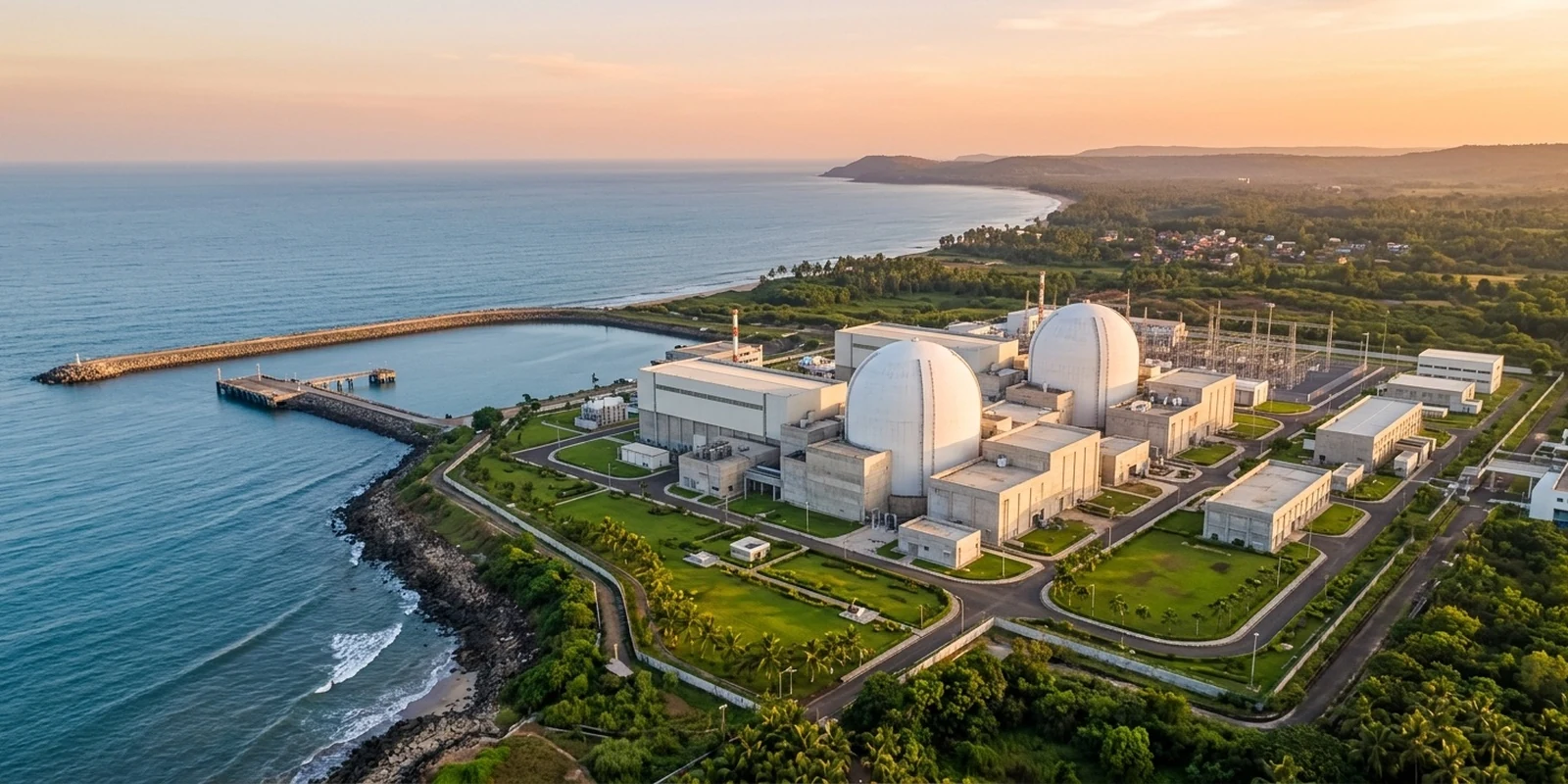
India’s nuclear reactors have kept 851 million tonnes of carbon dioxide out of the atmosphere since the first unit at Tarapur started up in 1969 — a figure the Press Information Bureau put on record in a backgrounder on 28 August 2026. It lands harder set against the fleet that produced it: 24 reactors, seven sites, 8.78 GW, under 2% of India’s installed capacity. Measured per gigawatt, the nuclear energy CO2 emissions avoided in India are the highest of any clean source the country runs — six times solar’s.
For where this fleet is going, see our earlier coverage: India’s nuclear power roadmap to 100 GW by 2047 for the capacity targets and reactor pipeline, and the SHANTI Act and private investment in Indian nuclear power for the policy opening. This piece is about what the reactors already running have displaced — and about the large part of the programme that has nothing to do with electricity.
Key Findings From The Government Backgrounder
The nine-page backgrounder draws on the Department of Atomic Energy, the AERB and NPCIL. The numbers that carry it:
- Fleet. 24 reactors at seven NPCIL stations, nine under construction, 10 more in preparation. Target: 100 GW by 2047.
- Funding. ₹20,000 crore for indigenous Small Modular Reactors in the Union Budget 2025–26.
- Healthcare. The Tata Memorial Centre registered 1.3 lakh patients in FY 2024–25 and screened five lakh women for cancer.
- Agriculture and food. 70 crop varieties bred at BARC, including the TBM-9 banana and RTS-43 sorghum in 2025; six new gamma plants took India to 40.
- Materials. A first electronics-grade Boron-11 enrichment facility at Talcher, and a first rare-earth reference standard — the fourth worldwide.
Why Nuclear Energy CO2 Emissions Avoided In India Run Highest Per Gigawatt
The comparison at the heart of the backgrounder is not about total output — solar and wind both generate far more electricity in India. It is about what one gigawatt achieves in a year.
| Clean energy source | CO2e avoided per GW, FY 2025–26 | Relative to solar |
|---|---|---|
| Nuclear | 5.4 million tonnes | 6.0× |
| Hydropower | 2.7 million tonnes | 3.0× |
| Wind | 1.6 million tonnes | 1.8× |
| Solar | 0.9 million tonnes | 1.0× |
Source: PIB Backgrounder, 28 August 2026.
The mechanism is running hours, not cleanliness
All four sources are carbon-free at the point of generation, so the gap says nothing about how clean each is. It is about how much of the year each runs. An Indian nuclear unit delivers roughly 80% of its rated output annually; solar manages around 20%, wind 25%, hydro follows the monsoon. A nuclear gigawatt therefore generates three to four times the electricity, displacing three to four times the coal — and because it runs through the night, when solar cannot, the gap widens to six-fold.
This is not an argument against solar
It is an argument about what each technology is for. India will not build 100 GW of nuclear this decade; it has already crossed 300 GW of non-fossil capacity, largely on solar, which deploys in months rather than a decade. Nuclear is different in kind — a small, dense block of firm supply available round the clock, which is what lets a grid absorb more variable generation. The two are complements, not rivals.
What Nuclear Technology Does In India Beyond Electricity
For most readers, “nuclear” means power stations. In India it means more, because the Department of Atomic Energy has always been a research establishment first, a utility second.
Healthcare: cancer therapy and sterilisation
BARC, IGCAR, the Tata Memorial Centre, TIFR and the Harish-Chandra Research Institute develop indigenous radiopharmaceuticals, imaging technologies and cancer therapies. The scale is not marginal: 1.3 lakh patients registered at the Tata Memorial Centre in FY 2024–25, five lakh women screened for oral, breast and cervical cancers, a 150-bed cancer hospital opened at Muzaffarpur, and 1.53 crore medical devices sterilised by indigenous radiation technology.
Agriculture and food: 70 crop varieties
Radiation-induced mutagenesis, combined with conventional cross-breeding, has given BARC 70 released crop varieties — the TBM-9 banana and RTS-43 sorghum joined in 2025 — bred for higher yields and tolerance to drought, heat, salinity and disease. After harvest, irradiation changes trade economics: longer shelf life lets mangoes reach export markets by sea rather than air.
Rare earths, semiconductors and hydrogen from reactor heat
Three newer applications sit inside India’s self-reliance agenda. The country has released its first certified reference material for rare earth elements — Ferrocarbonatite (FC) – BARC B1401, only the fourth such standard in the world. It has built its first electronics-grade Boron-11 enrichment facility at Talcher, at 99.8% purity, feeding the India Semiconductor Mission. And in June 2026 at Kalpakkam it commissioned the world’s first hydrogen plant driven by nuclear process heat rather than electricity — a carbon-free route alongside the electrolysis already putting hydrogen buses and trucks on Indian roads.
The Safety Framework Behind The Numbers
The backgrounder gives safety equal billing with applications, for reasons of perception rather than record: India has run reactors for 57 years without a radiological accident affecting the public, yet waste and radiation still dominate the conversation.
- Design. “Defence in depth”: ceramic fuel pellets in sealed zirconium alloy rods, inside a pressure vessel, inside reinforced concrete containment — engineered for earthquakes, floods, cyclones and tsunamis. India’s PHWRs carry two independent automatic shutdown systems.
- Dose limits. The AERB caps occupational exposure at an average 20 millisieverts a year over five years; the limit for the general public is 1 mSv a year.
- Waste. High-level waste is vitrified into stable glass blocks — technology BARC developed indigenously, held by only a handful of countries.
- Preparedness. AERB-approved on-site and off-site emergency plans, a 16-kilometre Emergency Planning Zone, district mock drills, and a completed post-Fukushima safety review at every plant.
The document also runs a myths-and-facts section — ground the Atomic Energy Regulatory Board and the Department of Atomic Energy both cover in more detail on their own portals.
What It Means For India’s Energy Transition
The first thing that follows is that nuclear’s climate contribution in India is systematically under-read, because it is read off installed capacity. At 8.78 GW the fleet looks marginal — under 2% of capacity — and transition commentary treats it that way. Judged by the nuclear energy CO2 emissions avoided in India since 1969, it is not marginal at all. Capacity is the wrong denominator for a carbon question; cumulative avoided emissions is the right one.
The second is that the case for expanding the fleet does not rest on carbon alone. Firming a renewables-heavy grid is the expensive part of the transition — India’s own battery and pumped storage buildout runs to lakhs of crores — and every gigawatt of round-the-clock low-carbon supply reduces how much storage has to be bought. Meanwhile the same establishment is producing cancer therapies, drought-tolerant sorghum, semiconductor-grade boron and hydrogen from reactor heat. The 100 GW target will be argued over on cost and timelines, as it should be — but better argued with the full ledger in view, which this backgrounder is the first to set out in one place.
Frequently Asked Questions
How much CO2 has nuclear energy avoided in India?
851 million tonnes of CO2-equivalent since Tarapur began operating in 1969 — the annual carbon sequestration of more than 38 billion mature trees.
Why does nuclear avoid more CO2 per gigawatt than solar or wind in India?
Running hours, not cleanliness. A nuclear unit delivers roughly 80% of rated output across a year, against about 20% for solar and 25% for wind, and it generates at night when coal would otherwise run. In FY 2025–26 one nuclear gigawatt avoided 5.4 Mt of CO2e against solar’s 0.9 Mt.
How many nuclear reactors does India have?
24 reactors across seven sites, 8.78 GW installed. Nine more are under construction and 10 are in preparation, against a 100 GW target for 2047.
What is nuclear technology used for in India apart from electricity?
Cancer diagnosis and therapy, radiopharmaceuticals and the sterilisation of 1.53 crore medical devices; 70 crop varieties bred at BARC; food preservation across 40 gamma plants; rare-earth analysis; semiconductor-grade materials; and hydrogen from nuclear process heat.
Source: Nuclear Energy in India — Applications, Safety, and Preparedness — PIB Backgrounder, Press Information Bureau, Government of India, 28 August 2026 (Release ID 2304032).