E85 And E100 Flex Fuel Vehicles In India: What The CMVR Amendment Changes
India now certifies E85 and E100 flex fuel vehicles under amended CMVR rules. What changes for carmakers, owners and the ethanol roadmap beyond E20.

India Rewrites Its Rules For E85 And E100 Flex Fuel Vehicles
- CMVR emission certification now names E100 alongside E85.
- Only certified flex fuel vehicles may use E85 or E100; E20 approval does not qualify a car.
- No mandate, no retrofit for existing owners.
- E85 is on sale at 48 outlets, targeted at about 5,000 by December 2027.
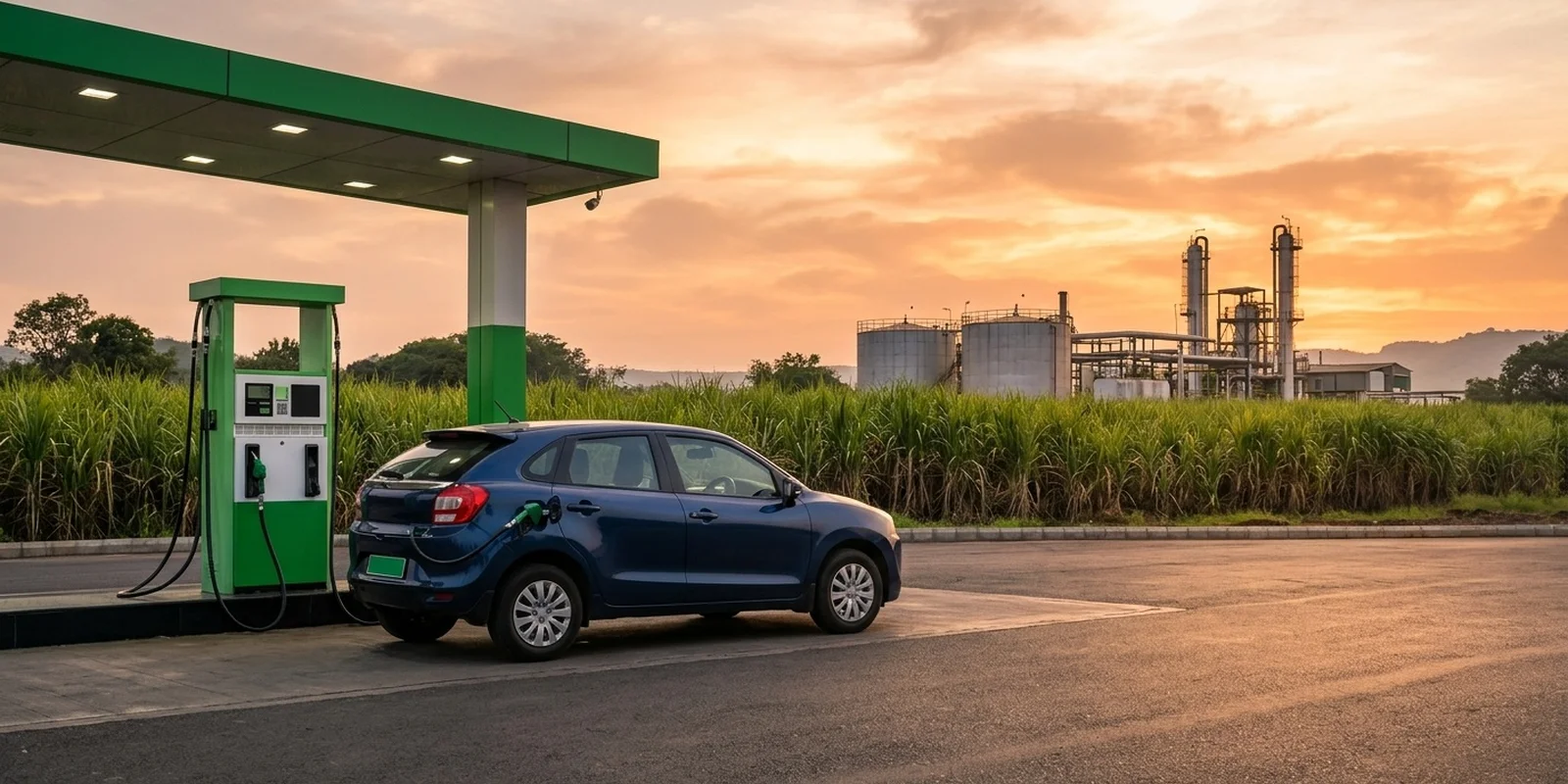
India has rewritten part of its motor vehicle rulebook for E85 and E100 flex fuel vehicles. On 26 October 2026 the Ministry of Road Transport and Highways (MoRTH) said it had notified amendments to the Central Motor Vehicles Rules (CMVR), 1989, bringing E100 into the emission certification provisions next to E85. The rules apply from their publication in the Official Gazette.
The scope is narrow: no fuel mandate, and no change for cars already on the road. It completes the certification groundwork carmakers need to sell vehicles running on mostly-ethanol fuel.
What The CMVR Amendment Changes For E85 And E100 Flex Fuel Vehicles
E100 is now named in certification
Per the MoRTH release, the emission certification provisions now expressly include E100 alongside E85. Certified vehicles must still meet the emission and safety requirements of their category, so ethanol earns no softer tailpipe limits.
E85 is a petrol-ethanol blend with up to 85% ethanol by volume. E100 is fuel consisting predominantly of ethanol.
What else the notification touches
It also updates biodiesel provisions and makes technical corrections. Trade-press readings of the gazette text report biodiesel testing references moving from B10 to B100, and the weight limit for standard chassis-dynamometer emission tests rising from 3,000 kg to 3,500 kg. The PIB release does not list these details.
Who The Rules Apply To, And Who They Don’t
The ministry is deliberately explicit, given the public debate that followed E20 becoming the national pump fuel:
- E20 approval is not enough. A car rated for E10 or E20 is not, by that fact, suitable for E85.
- No retrofit, no mandate. Existing owners need not switch fuel or modify vehicles, “either at present or in the future”.
- The sticker decides. Check the fuel-compatibility sticker and owner’s manual before choosing a fuel.
How Flex Fuel Vehicles Work
A flex fuel vehicle runs on any petrol-ethanol mix within its certified range, from a single tank. Its fuel-system materials are chosen for high-ethanol blends, and its engine controls sense the fuel and adjust automatically.
The technology is proven abroad: the Ministry of Petroleum and Natural Gas (MoPNG) says over 80% of Brazil’s light-vehicle fleet runs on it (stated, PIB, 5 June 2026). India’s first mass-market models arrived in June 2026, with E20-to-E85 motorcycles on 3 June and the first flex fuel passenger car on 4 June.
Where The Rule Fits In India’s Ethanol Roadmap Beyond E20
Our explainer on E20 petrol and the Ethanol Blended Petrol Programme covers blending so far; flex fuel is the next stage. MoPNG launched E85 on 5 June 2026 with this plan:
Figures stated by the Ministry of Petroleum and Natural Gas (PIB, 5 June 2026).
That is roughly a tenfold expansion in seven months, then another tenfold in twelve (our calculation). Supply makes it plausible: ethanol procurement rose from about 38 crore litres in Ethanol Supply Year 2013-14 to more than 1,040 crore litres, a roughly 27-fold increase (stated figures, PIB, 4 June 2026; multiple is our calculation).
Demand depends on vehicles. MoPNG estimates that if half of new two- and four-wheeler sales went flex fuel, ethanol demand would rise by about 311.8 crore litres a year, with around 66.4 lakh tonnes less CO2 (stated).
What Still Has To Be Solved
Certification removes a legal barrier, not an economic one. Ethanol holds less energy per litre than petrol, and US government fuel economy data shows about 15% to 27% lower mileage on E85 (stated). MoPNG prices E85 nearly ₹20 a litre below petrol (stated).
A flat ₹20 discount covers a 27% mileage loss only while the comparison fuel costs under about ₹74 a litre (20 ÷ 0.27), and a 15% loss up to about ₹133 (20 ÷ 0.15). India’s gap should sit nearer the low end, since its reference fuel is already E20.
The rest sits with tax policy. The petroleum minister has asked states for enabling taxes on E85 and flex fuel vehicles, and road-tax concessions are under study. Neither is in this notification.
E85 And E100 Flex Fuel Vehicles Beside EVs And Hydrogen
Flex fuel is one lane in India’s transport decarbonisation mix, not a rival to the others. MoPNG cites a 61% lifecycle emissions cut for E85 vehicles (stated), though MoRTH itself says benefits depend on feedstock and process. Hydrogen is being tested at the heavy end, as our report on India’s hydrogen bus and truck pilots shows.
Electric mobility has already moved past pilots. Across the Yellow Haze group, charging software has handled 2M+ sessions and 50 GWh+ of energy, and YoHub makes 75,000+ stations reachable worldwide (stated, company data). That runs on software for charge point operators and fleet charging management that treat every vehicle as a grid asset. Ethanol trims crude imports for engines India still builds; electrification makes the vehicle part of the energy system.
Frequently Asked Questions
Can I use E85 or E100 in my current petrol car?
No. Only vehicles designed and certified for these fuels may use them. E10 or E20 approval does not make a car E85-ready.
Does the CMVR amendment force owners to switch?
No. Existing owners are not required to switch to E85 or modify their vehicles, now or in future.
What is the difference between E85 and E100?
E85 contains up to 85% ethanol by volume; E100 is predominantly ethanol. Each flex fuel vehicle is certified for a specific range.
Where can I buy E85 in India?
At 48 public-sector outlets from 5 June 2026, with about 500 targeted by December 2026.
Source: Ministry of Road Transport and Highways (MoRTH) updates rules to facilitate E85/E100 flex fuel vehicles — PIB Delhi, Ministry of Road Transport & Highways, 26 October 2026 (Release ID 2328642).