

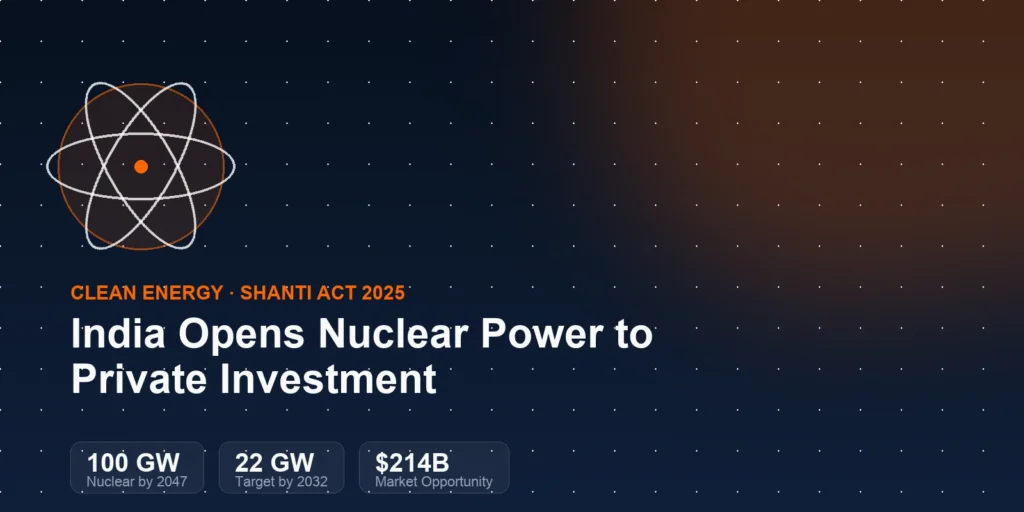
💡 India’s Nuclear Energy Roadmap 2047: Key Highlights
- 100 GWe by 2047 — the Nuclear Energy Mission’s target, up from 8.78 GW today, per a roadmap the Department of Atomic Energy (DAE) disclosed to Parliament in full for the first time.
- Trajectory: ~22 GW by 2031-32 (projects underway) → 54 GW by 2047 via NPCIL’s fleet → the remaining 46 GW from PSUs, states, private players and joint ventures.
- The Prototype Fast Breeder Reactor (PFBR) reached first criticality on 6 April 2026 — India’s formal entry into Stage 2 of its three-stage, thorium-bound nuclear programme.
- Three Small Modular Reactor designs are in development; at least 5 SMRs are targeted operational by 2033.
- The SHANTI Act, 2025 opens nuclear power to private capital for the first time; rules are still being drafted, but liability is now capped from ₹100 crore to ₹3,000 crore per incident by reactor size.
India’s nuclear energy roadmap to 2047 just became a lot more concrete. In five written replies to Parliament on 23 July 2026, the Department of Atomic Energy laid out how the country plans to grow nuclear capacity more than elevenfold — from 8.78 GW today to 100 GW by 2047 — while confirming its Fast Breeder Reactor has already crossed a milestone many assumed was years off, and that rules opening the sector to private capital are now being drafted.
The 100 GW Roadmap: How India Gets There By 2047
The Nuclear Energy Mission (NEM), announced in the Union Budget 2025-26, set the headline number — 100 GWe by 2047, framed against India’s net-zero-by-2070 goal. What the DAE’s 23 July replies added was the roadmap behind it: a staged build-out, not a single leap.
The Build-Out, Stage By Stage
Today’s 8.78 GW is expected to reach ~22 GW by 2031-32 from projects already under implementation. NPCIL’s indigenous PHWR/LWR fleet is expected to add another 32 GW by 2047, taking the total to ~54 GW. The remaining 46 GW — nearly half the target — is left to other PSUs, state governments, private companies and joint ventures under various business models. That last segment is where the SHANTI Act’s private-sector opening becomes structural, not symbolic.
Small Modular Reactors: The Faster, Flexible Piece
BARC is developing three SMR designs, each past initial approval: the 220 MWe Bharat Small Modular Reactor (BSMR-200) and the 55 MWe SMR-55, both with in-principle construction approval and a site at Tarapur, Maharashtra; and a High Temperature Gas Cooled Reactor (HTGCR, up to 5 MWth) built specifically for hydrogen production, sited at BARC Vizag. The Mission’s goal is at least 5 indigenous SMRs operational by 2033 — a much nearer-term marker than 2047.
The Fast Breeder Reactor Milestone: India Enters Stage 2
India’s nuclear programme runs on a three-stage design built around one fact: limited uranium, but among the world’s largest thorium reserves. Stage 1 uses natural uranium in PHWRs — mastered indigenously. Stage 2 uses plutonium recovered from reprocessed PHWR fuel in Fast Breeder Reactors (FBRs), which produce more fissile material than they consume. Stage 3, still years away, would run on uranium-233 bred from thorium-232.
India formally entered Stage 2 on 6 April 2026, when the indigenously designed Prototype Fast Breeder Reactor (PFBR) at Kalpakkam — built by Bhavini to an IGCAR design, nearly 90% indigenous — attained first criticality, the point at which a reactor sustains its own chain reaction. The government has since cleared pre-project activities for two more 500 MW fast breeder units at Kalpakkam — the first sign Stage 2 is moving from prototype to fleet.
The Construction Pipeline: 13 Reactors, 10,600 MW
The 2031-32 interim target isn’t aspirational — it’s under construction. Over the last decade, 13 reactors totalling 10,600 MW have moved through construction and commissioning. Four (3,100 MW) are already commercially operational — KKNPP-2, KAPP-3&4, RAPP-7 — and nine more (7,500 MW), including RAPP-8 and KAIGA-5&6, are still being built. The government has also cleared the next wave: ten more indigenous PHWRs in fleet mode plus two more Kudankulam units with Russia — a pipeline built around NPCIL’s existing playbook, which is why the roadmap needs the SHANTI Act’s private-sector opening to reach the remaining 46 GW.
SHANTI Act: Opening The Door To Private Capital
The SHANTI Act, 2025 is what makes that 46 GW plausible rather than a placeholder — for the first time, it opens nuclear generation to private and joint-venture participants and gives the Atomic Energy Regulatory Board statutory independence. We covered the Act’s early stakeholder consultations in our earlier piece on nuclear energy opening up to private investment; this update covers what’s changed since — the rules that let a private company actually operate a reactor.
Those implementing rules are “currently in drafting stage,” per the DAE, and will be notified before any private licence applications are considered. What is now spelled out is the liability framework private operators will work under, under Sections 13-14 of the Act:
| Reactor category (thermal power) | Operator’s maximum liability per incident |
|---|---|
| Above 3,600 MW | ₹3,000 crore |
| Above 1,500 MW, up to 3,600 MW | ₹1,500 crore |
| Above 750 MW, up to 1,500 MW | ₹750 crore |
| Above 50 MW, up to 750 MW | ₹300 crore |
| Up to 150 MW, plus fuel-cycle and transport facilities | ₹100 crore |
The overall ceiling is 300 million Special Drawing Rights; beyond an operator’s cap, the Central Government becomes liable — for damage above the cap, at government-owned installations, or from a natural disaster, war or terrorism. A tariff-funded Nuclear Liability Fund backstops this, and every private operator must carry insurance before starting operations — a framework built to answer the one question that has kept private capital out for six decades: who pays, and how much, if something goes wrong.
What It Means
India’s renewable capacity has nearly quadrupled since 2014 to 288.58 GW, but solar and wind are intermittent — they need firm, always-on baseload to lean on, and nuclear’s 8.78 GW today is a small slice of the 297.36 GW non-fossil total the two make up together. A 100 GW nuclear roadmap isn’t competing with that renewable growth; it’s the steady counterweight the grid needs as coal is phased down. Two long-standing uncertainties just got smaller: the PFBR’s criticality moves Stage 2 from theory to an operating reactor plus two more in the pipeline, and the SHANTI Act’s liability framework gives private investors a tiered answer to the question that had kept them out — even if the rules to act on it are still being written.
Frequently Asked Questions
What is India’s nuclear energy roadmap for 2047?
India aims to grow nuclear capacity from 8.78 GW today to 100 GWe by 2047 — ~22 GW by 2031-32 from projects underway, 54 GW by 2047 via NPCIL’s fleet, and the remaining 46 GW through other public and private players.
What is the Prototype Fast Breeder Reactor and why does it matter?
The PFBR is India’s indigenous 500 MW fast breeder reactor at Kalpakkam. It attained first criticality on 6 April 2026, marking India’s entry into Stage 2 of its three-stage nuclear programme, which eventually unlocks large-scale thorium use.
What is the SHANTI Act and how does it affect private investment in nuclear power?
The SHANTI Act, 2025 opens India’s nuclear power sector to private and joint-venture participation for the first time. Its implementing rules — governing how private companies apply for licences — are still being drafted as of July 2026.
How much will private nuclear operators be liable for in case of an accident?
Liability per incident is capped by reactor size, from ₹100 crore (up to 150 MW) to ₹3,000 crore (above 3,600 MW). The Central Government covers damage beyond these caps, and private operators must carry insurance to cover their share.
Source: Department of Atomic Energy, written replies in the Lok Sabha/Rajya Sabha — PRID 2288294 | 2288295 | 2288296 | 2288298 | 2288299, PIB Delhi, 23 Jul 2026.